Any resemblance to… etc., etc.
Scanreigh/Thomas Zitzwitz
Any resemblance to… etc., etc.
Acrylic on canvas, 195 × 135 cm
Private collection
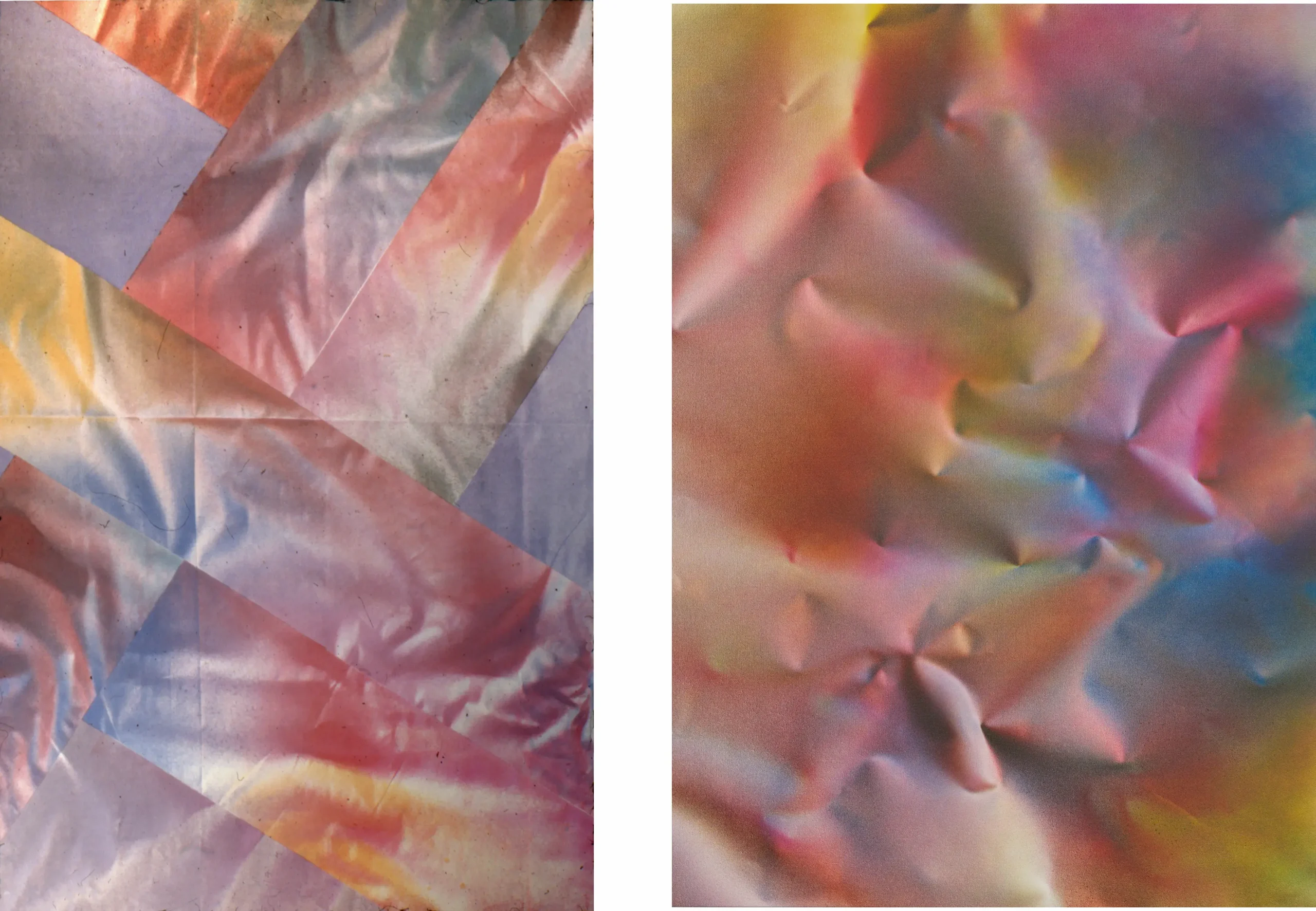
on the right: Zitzwitz, Sans titre, 2022
Acrylic on canvas, 86 × 62 cm
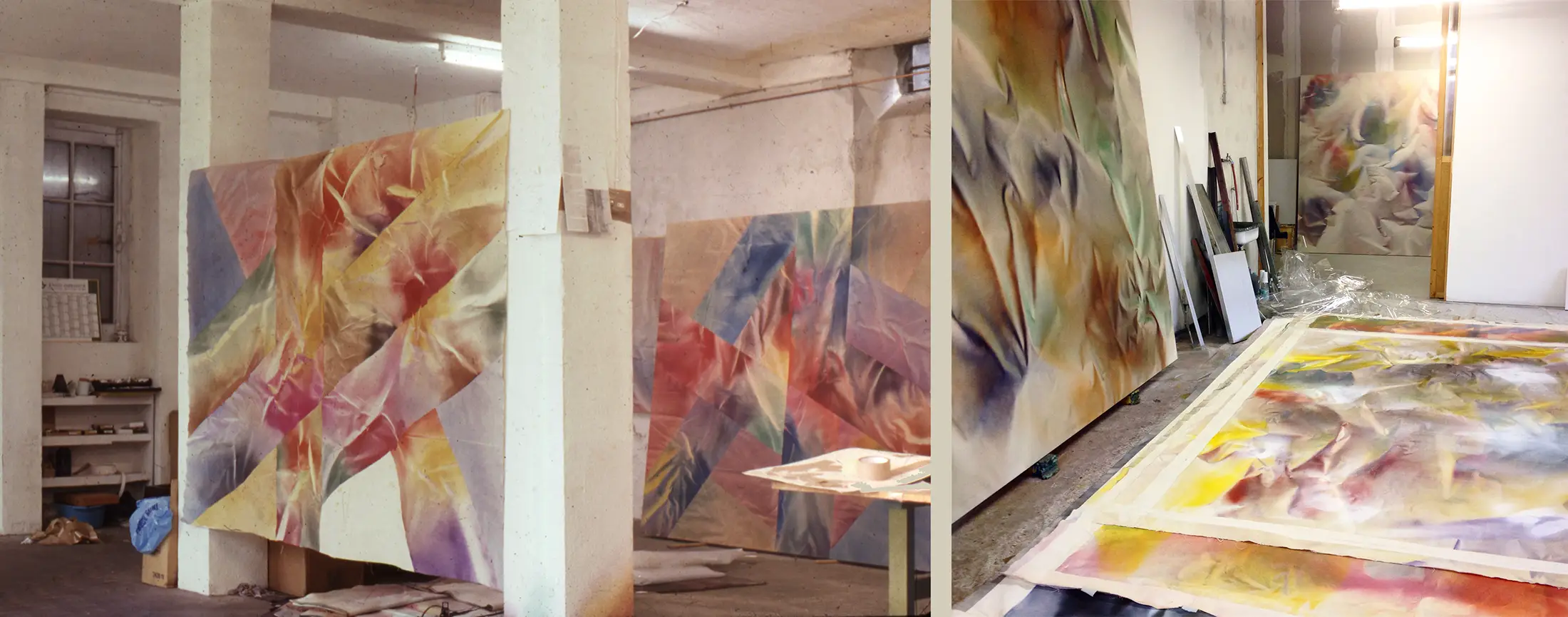
Hard not to react to the spray paintings of the German artist Thomas Zitzwitz. They are clearly reminiscent of the spray-gun painting that Scanreigh practised for just under ten years in his early days. The two artists are 14 years apart. On the website of the Galerie Richard I read, in a text by the German art historian Barbara Hess, that Zitzwitz’s first spray paintings date from 2008. Scanreigh’s first spray-gun paintings date from 1974. In keeping with his approach at the time – minimalist and almost monochrome – the mark of the folds is light at first, but it will keep growing stronger and more intense in colour until this intriguing aesthetic passing of the baton, years later, between two artists who do not know each other.
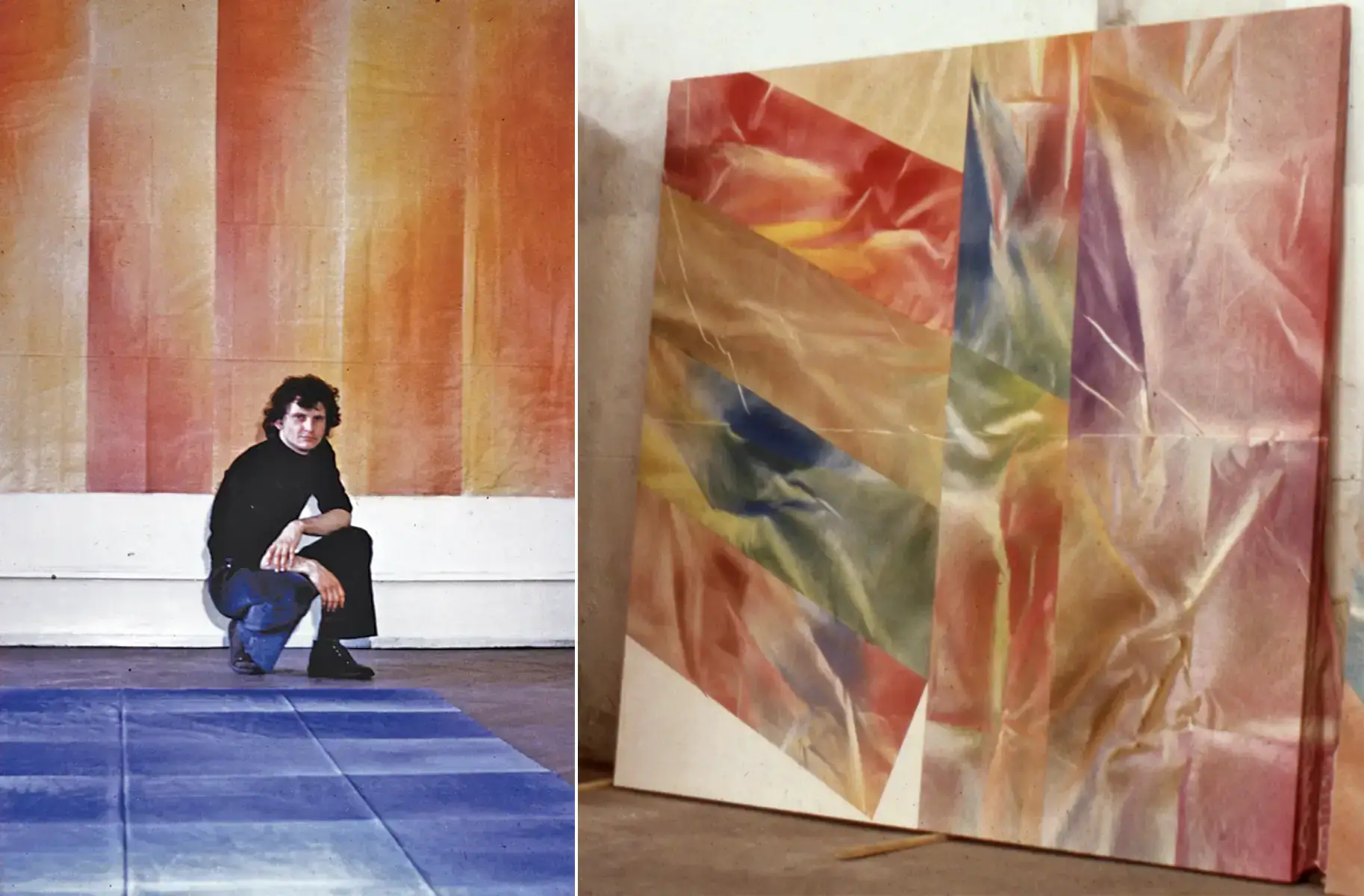
studio views 1974 and 1980
Thirty-four years separate the attention each of them paid to the same phenomenon. Both obtained relief effects by mechanically spraying colour onto a canvas that was not flat and was deliberately disturbed with irregularities, so that the thin layers of sprayed colour would settle differently according to the orientation of the canvas’s unevenness. In Zitzwitz there is a reference to John Cage’s “prepared piano”. Scanreigh does not invoke Cage but, like almost all European artists, he was nourished by the same American artistic avant-garde from before and after the Second World War. And both artists invoke Simon Hantaï (1922–2008), in particular the works he obtained by applying his paint to canvas that had first been knotted over its whole surface and that he then unfolded to reveal a network of imprints in the white of the canvas.
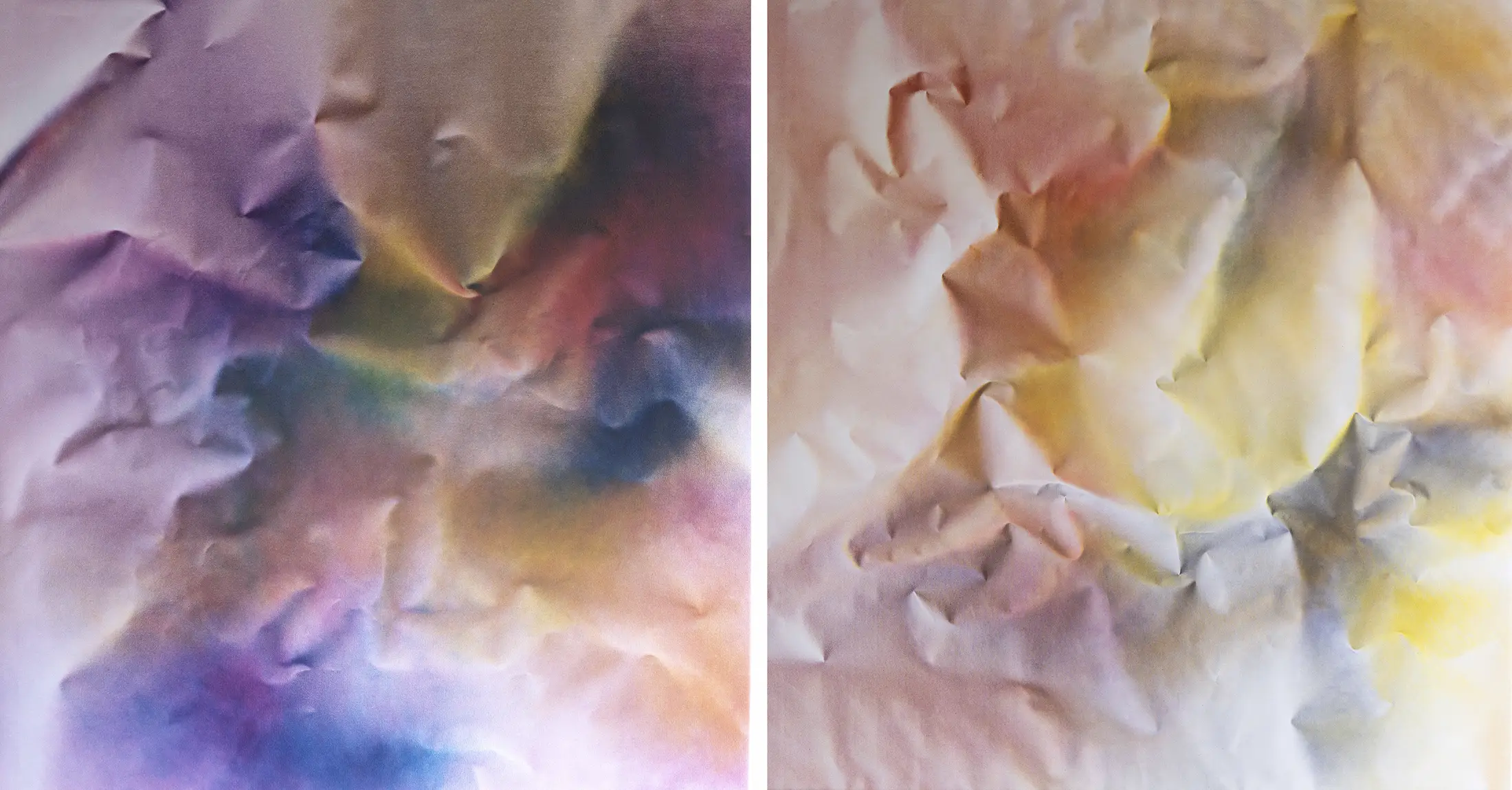
Acrylic on canvas
The German Björn Vedder, philosopher and independent curator, has devoted several texts to Thomas Zitzwitz. He notes that this sprayed painting lets the material exercise its own power, as a metaphor for our actions. Just as the random folds only reveal themselves at the moment the paint is applied, the contingencies of the reality in which we act only reveal themselves to us at the moment we act. In the 70s Scanreigh might have subscribed to this in part, but he was more in control, knowing what he was going to/wanted to obtain, the only thing to fear being the failures of the spray gun (drips and blots). The difference with him is that the surfaces treated by spraying are set within a structure from the outset. First simple vertical bands, then more elaborate arrangements of bands. A tension with the objective outer limits of the painting (with or without stretcher) arises from this inner division. The straight dividing lines produced by the tape cut to the quick of the colour, set themselves against its fluidity in a coercive arrangement that recalls the great internal antagonisms of the history of painting (more theoretical than artistic, as it happens) which, in the Italian Renaissance and later in France, set colour against drawing, each playing on its precedence according to the artists, periods and commentators.
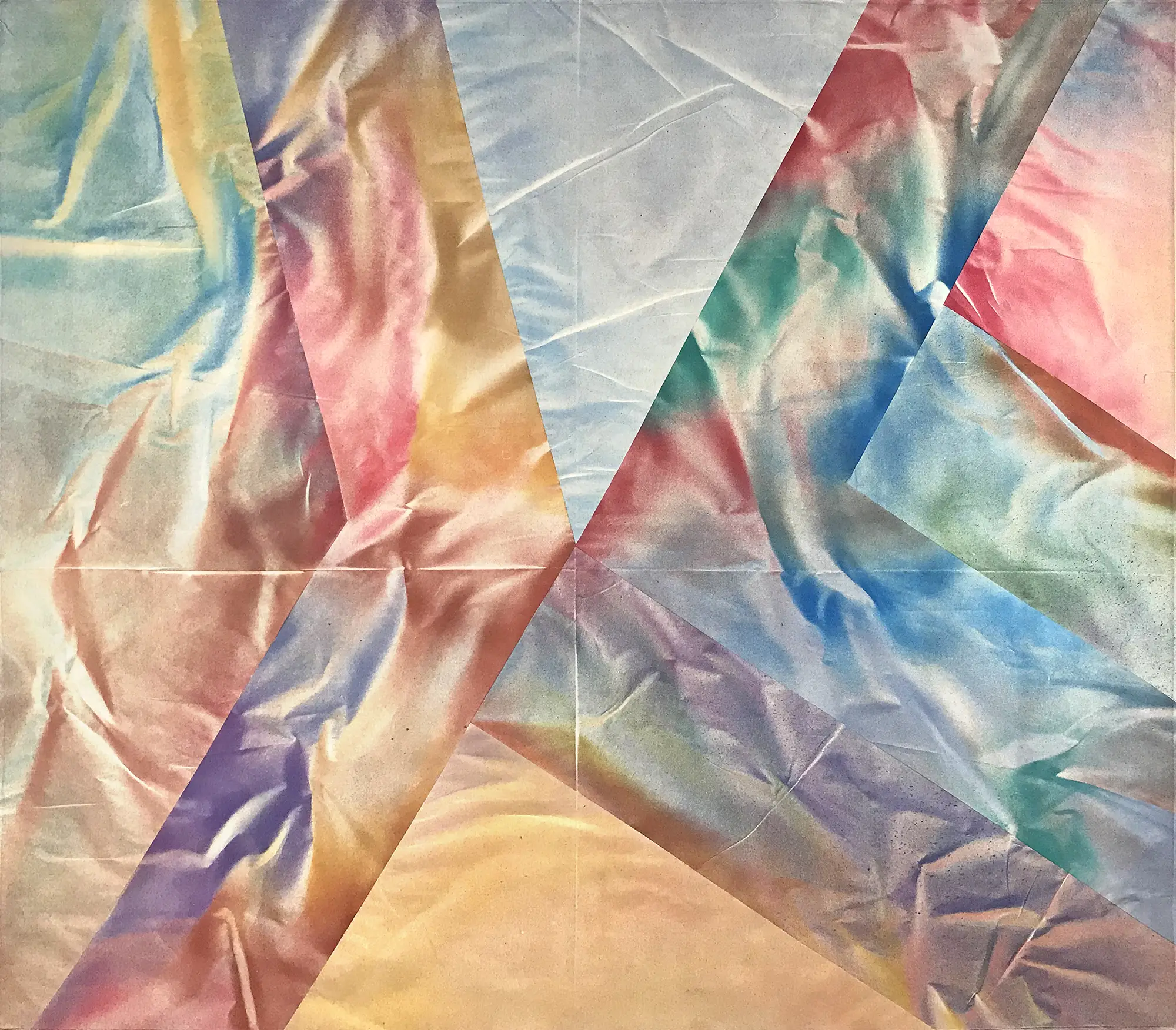
Acrylic on canvas, 200 × 220 cm
[1980 012]
With Zitzwitz, the reflection seems more phenomenological – philosophical – and indeed Barbara Hess’s critical text opens with an epigraph from Gilles Deleuze, taken from the book Le Pli. Leibniz et le baroque, published in 1988, a date by which Scanreigh had already put the question of the fold behind him several years before.
on the right Zitzwitz, c. 2021
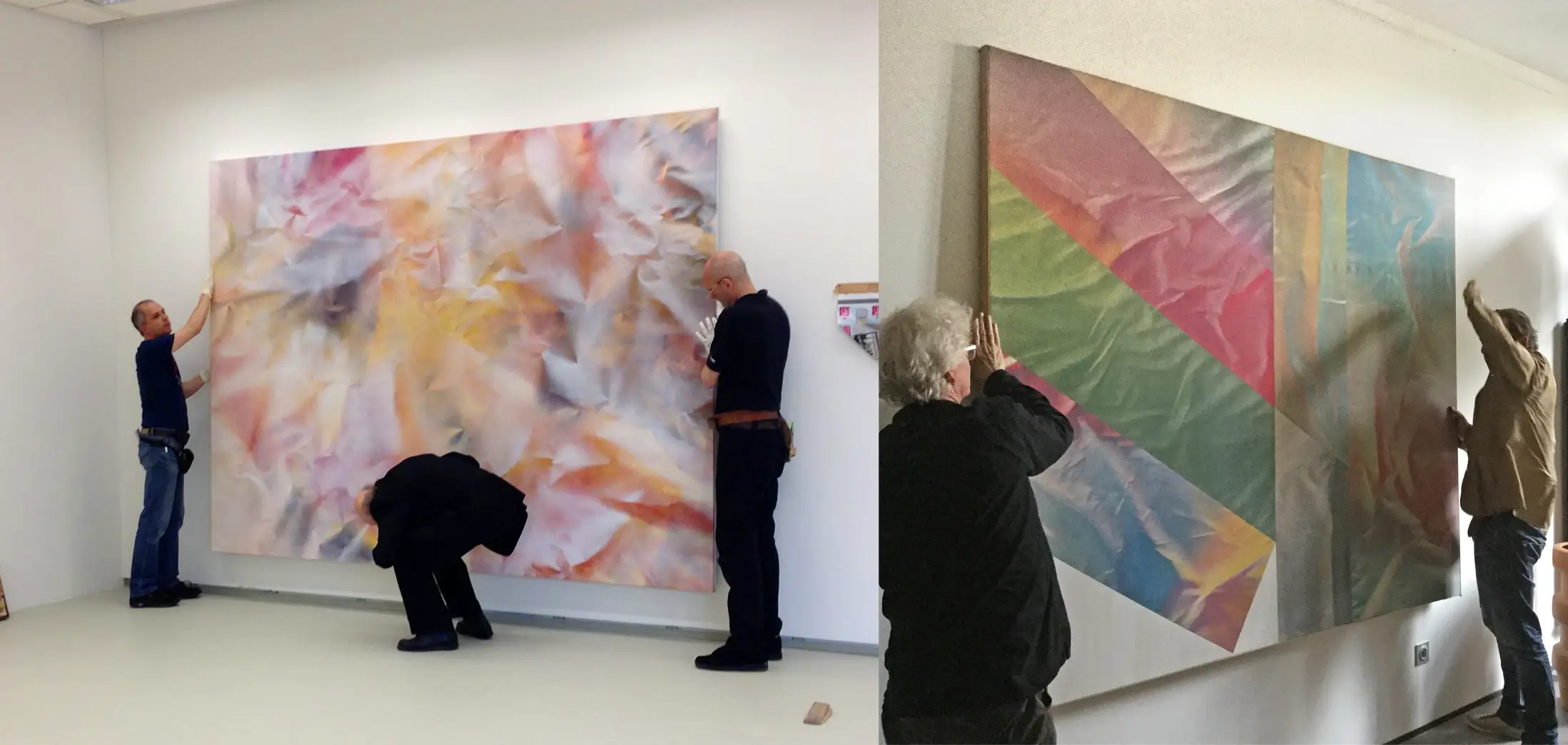
What distinguishes the two artists, apart from the presence/absence of an internal structure, is also a greater difference of scale in the relief effects in Zitzwitz’s work. But obtaining these effects by mechanically spraying colour is, in principle and technically, identical. For both of them, this body of sprayed works coexists with other works. In Scanreigh’s case they are the origin of a “gestative” evolution, an aesthetic mutation in which the various disciplines taken up (painting, printmaking, drawing) proceed from a series of engenderings. In Zitzwitz’s case the spray paintings seem to belong to a sequence bound to close, more along the lines of a set of variants calling for other sequences in the manner of musical variation. The fact remains that each of the approaches produces, three decades apart, an interference of curious a-temporality in the possibilities of creation. F.B.
Thomas Zitzwitz is represented in France by the Galerie Richard – Paris 74 rue de Turenne/3 impasse Saint-Claude, 75003 Paris
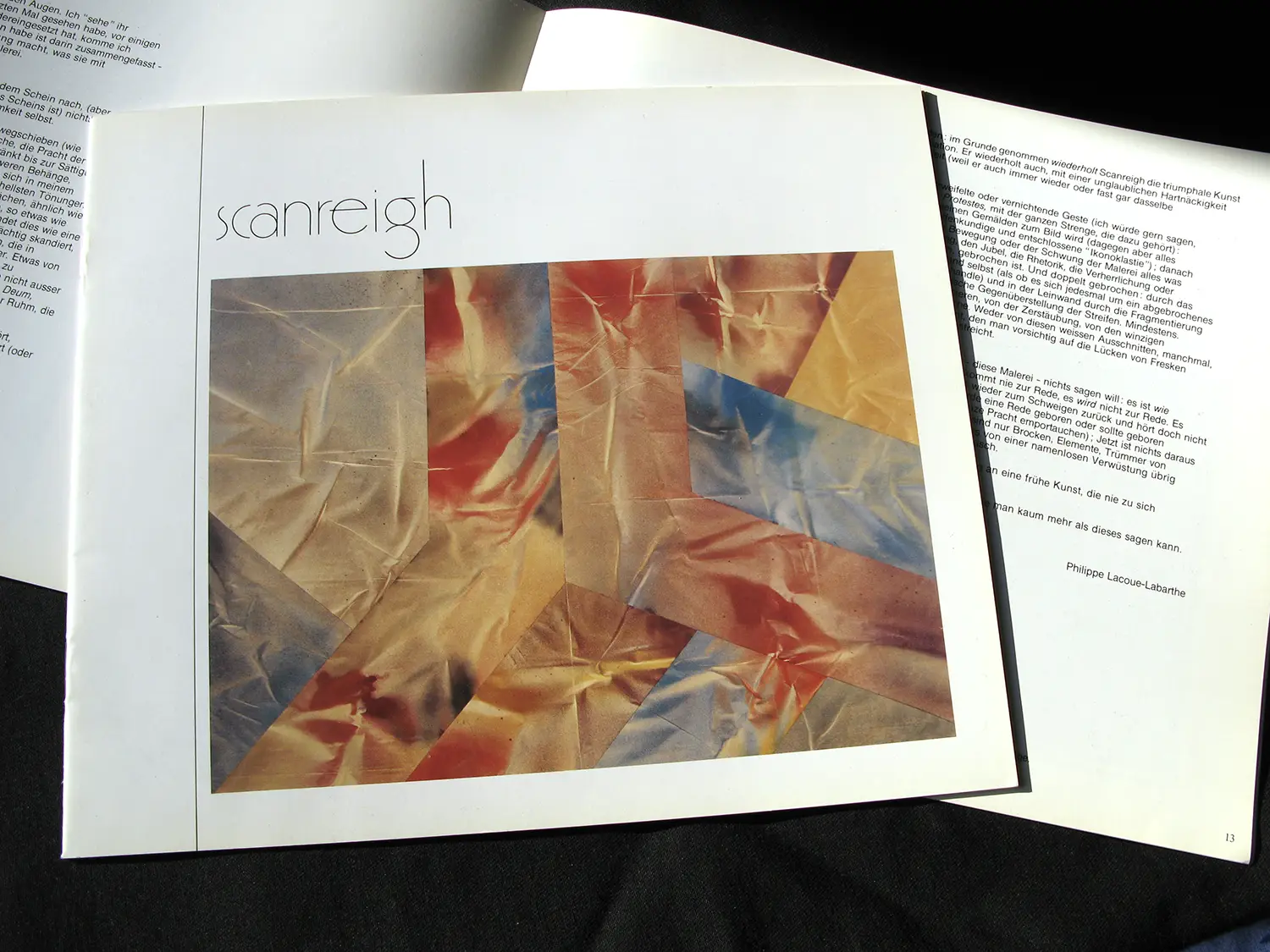
Exhibition catalogue, galerie Dominique Marchés, Châteauroux, Dec. 1980 – 15 Jan. 1981
Text by Philippe Lacoue-Labarthe
(French, English, German)
21 × 25 cm, 22 pages, 9 reproductions
[1980 001]