Avant-guerre, sur l’art etc – The end
[continued from the article Avant guerre – the beginning]
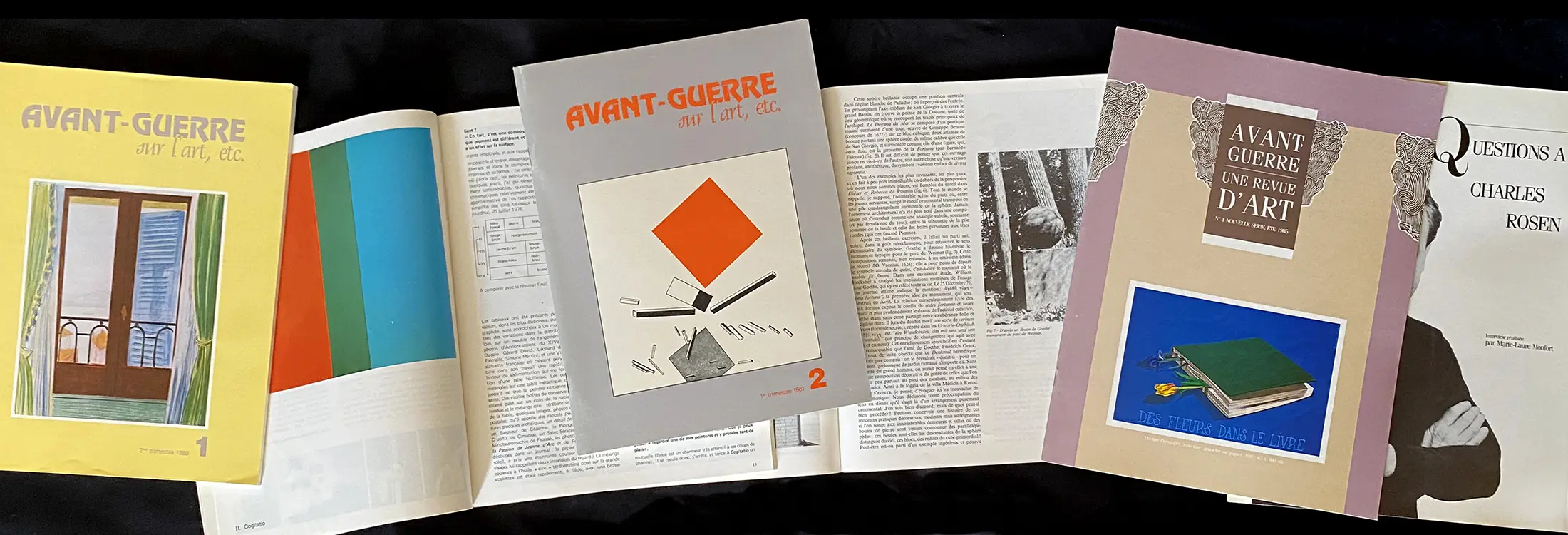
The second issue of Avant-Guerre sur l'art, etc. came out during the first quarter of 1981. Gathering texts proved rather easy. It was financing and distribution that were the sinews of war – avant/après making no difference! Then came the geographical scattering of one and all, professional life no longer allowing the energy-hungry sidelines of such an ambitious review. To keep it alive, we would have had to become professionals. But each of us was committed to a different path, one that took priority. Scanreigh and I brought out the last issue in 1985. Didier Semin, in his afterword to the republication by L’Echoppe of an article by André Chastel that appeared in our no. 2 of Avant guerre, speaks of it thus:
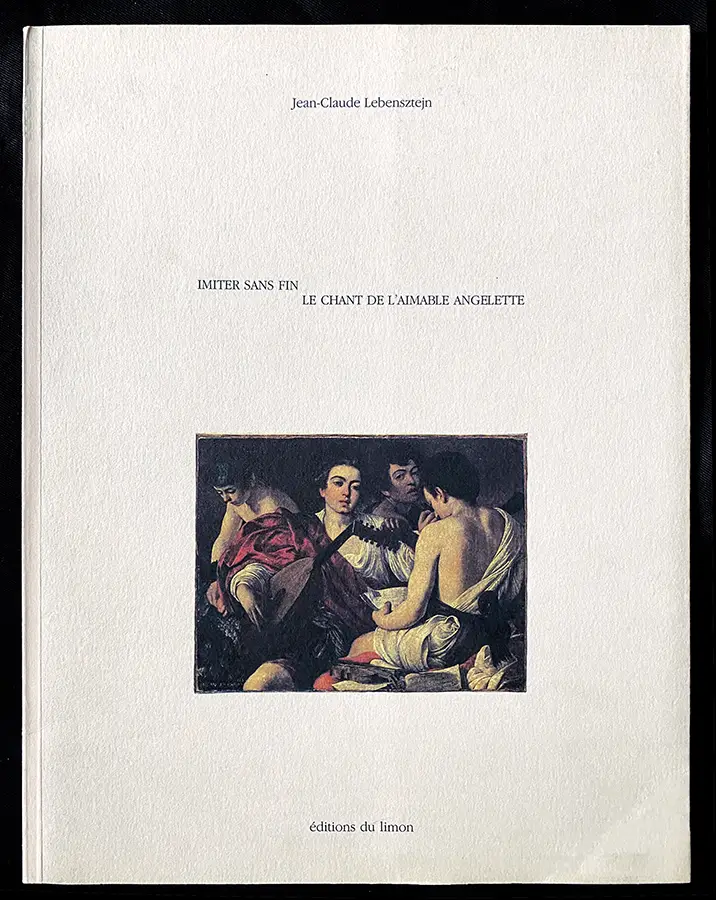
[…] “Issue no. 3 did not appear until 1985, under the aegis of an association created for the occasion and aptly named ALEA (Amis de l’édition artistique), which handed over its funds that same year to the éditions du Limon to allow the publication of a text by Jean-Claude Lebensztejn on Monteverdi (‘Imiter sans fin le chant de l’aimable angelette’): this slim volume, which cannot exactly be defined as a review, was nevertheless delivered to the subscribers who had signed up for four issues; honour was saved. The names of most of the authors who appear in the tables of contents map out what was our network of accomplices in the literary and academic world: Éric Michaud, Roland Recht, Jean-Luc Nancy and Philippe Lacoue-Labarthe had been our teachers in Strasbourg, in art history or in philosophy. They had introduced us to Jean-Claude Lebensztejn, Jean Louis Schefer, Eric Darragon (all three of whom agreed to join Éric Michaud on a short-lived editorial board), Henri Zerner, Charles Rosen, or Yve-Alain Bois. The translations of Einstein and Dvořak were provided by Bertrand Badiou, with the help of Christian Bernard.
So the text by André Chastel is probably the only one the author entrusted to us without being prompted by friendly pressure, apart from a recommendation, probably, from Éric Darragon, whose discretion prevented him from boasting of it to us in any way whatsoever. Christian Bernard had sent the historian the first issue of the review in June 1980, presenting our project (we were not short of nerve) as an attempt at a synthesis between Artforum and La Revue de l’Art, which Chastel had founded in 1968. […]
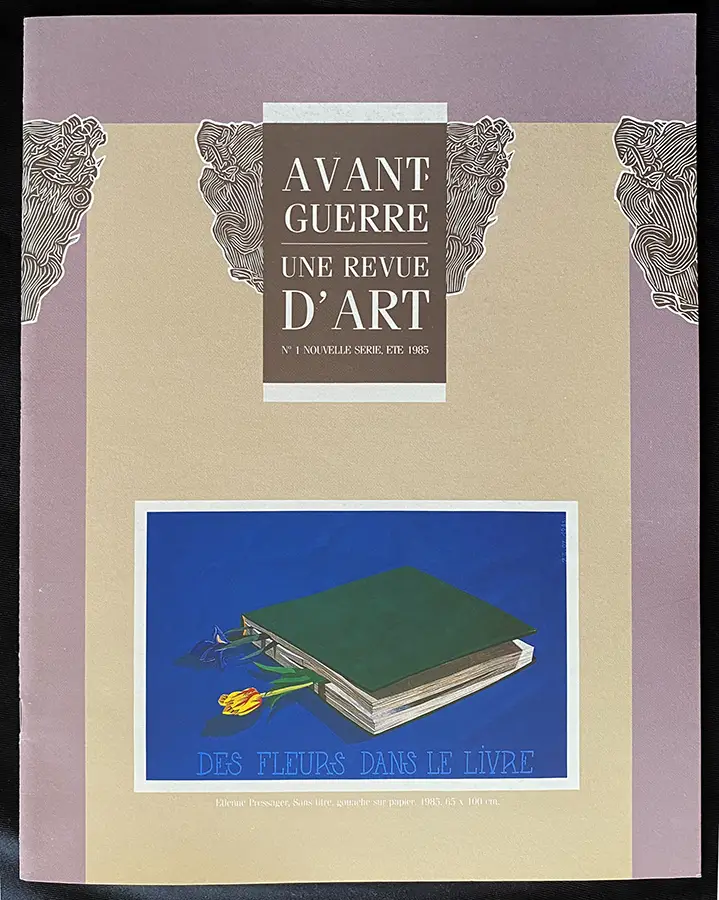
Despite its allegiance to the aesthetic codes of the eighties, no. 3 of the review was its swan song. Not only was a page being turned, but everything had changed while we waited for this last issue. Friendships, relationships, places, all the cards had been reshuffled; relief and intaglio printmaking and lithography, which had arrived in force in Scanreigh’s practice, gave “publishing” a whole new definition. And I, having got my hand in, had produced the Scanreigh catalogue for the Artothèque de Lyon, place des Terreaux, and another for Soulages… (I still kick myself for not asking him to sign the catalogue one evening when the whole Artothèque team was gathered with him at a restaurant.)
For Scanreigh, with everything interacting with everything, sculpture, printmaking, painting, the path to the artist’s book opened quite naturally … or more precisely reopened, for there had been precedents.
— In 1976: Les “blancs” en effet, a book with typewritten permutations by Jean-Claude Lebensztejn based on an extract from Stéphane Mallarmé’s preface to Un coup de dé jamais n’abolira le hasard, accompanied by rubber stamps by Scanreigh, several sheets of whose screenprinted text, before the pages were cut, bear abstract watercolours, representing a sort of prototype of the artist’s book
— In 1977: Ohne Nowhere, travel-diary poem by Christian Bernard, a book whose 15 deluxe copies are accompanied by drawings in soft pastel or in watercolour, depending on the copy.
— In 1984: Heyst, Éditions Baby Lone, which launched the collaboration with Daniel Sardet on a series of books among the finest and most refined made by Scanreigh.
But by 1985 we no longer knew what to think of the Avant-guerre episode. It was repressed before we could assign it a place. To tell the truth, it is not for us to do so …
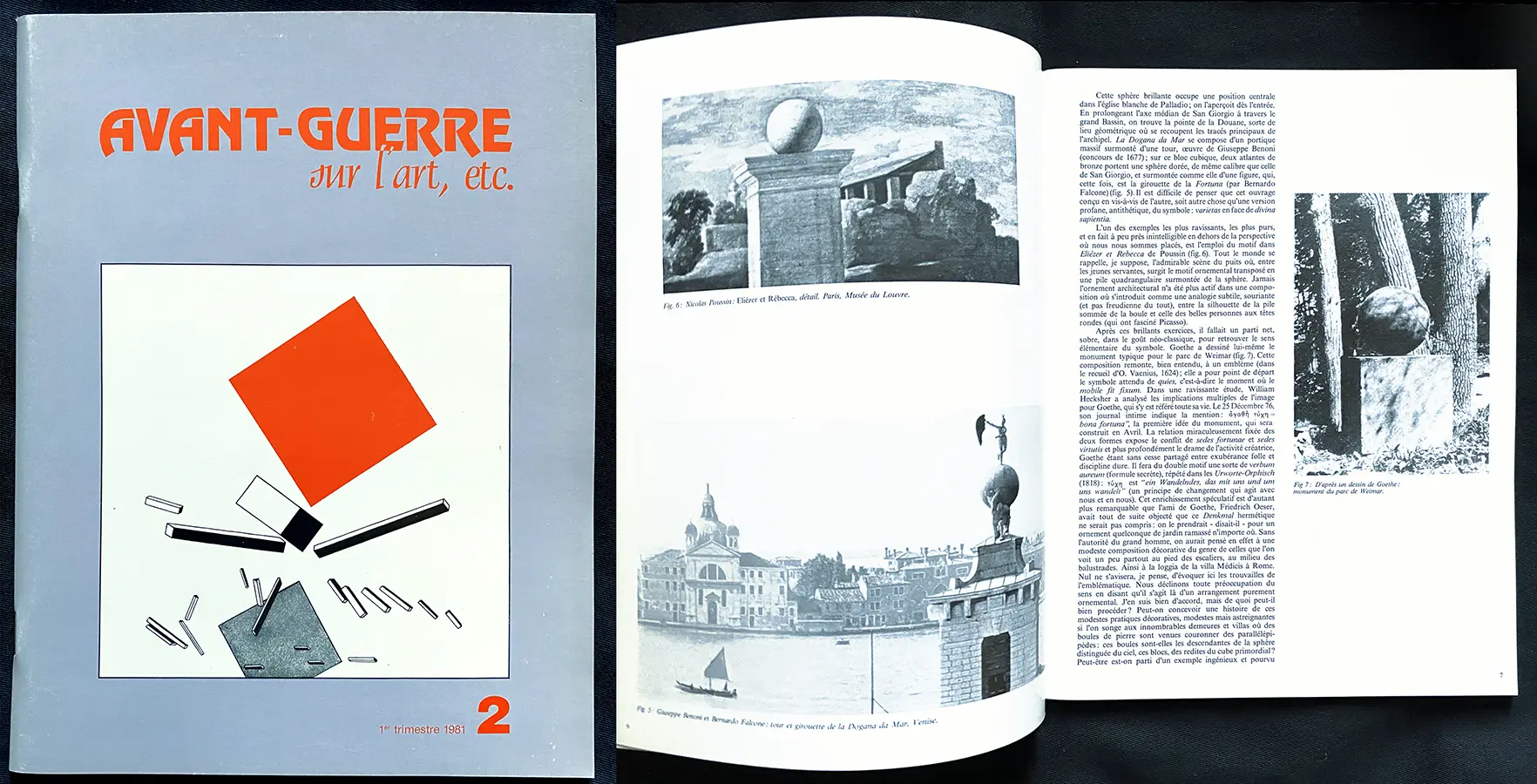
— Avant-guerre no. 2, 1st quarter 1981: André Chastel, La sphère et le cube; Carl Einstein, Braque le poète; Eric Darragon, Manet et la mort foudroyante; Harold Rosenberg, Joan Mitchell ; Philippe Lacoue-Labarthe, Venise, légendes ; Pontormo, Michel-Ange : lettres à Varchi, presented by Jean-Claude Lebensztejn; Yve-Alain Bois, El Lissitzky, didactiques de lecture ; Autour d'Hölderlin : l'Antigone de Sophocle / J. Derrida, R. Laporte, J.-L. Nancy, A. Rimoux; Pascal Bonafoux, Miroir, mort, métamorphose
— Avant-guerre no. 3, summer 1985: Roland Recht, Jardins avec paysage, ruines et ouvriers; Roland Recht, Fenêtre sur jardin [on the film by Peter Greenaway, The Draughtsman’s Contract]; Philippe Favier, six etchings made on tin-can lids, reproduced at actual size; Charles Rosen, Interview by Marie-Laure Monfort; Eric Darragon, François Boisrond dans le monde flottant.
On the cover: a drawing by Étienne Pressager
— To close the subscription to the review Avant-Guerre: Jean-Claude Lebensztejn, Imiter sans fin le chant de l’aimable angelette, [on Monteverdi], Éditions du Limon, Lyon, 1987