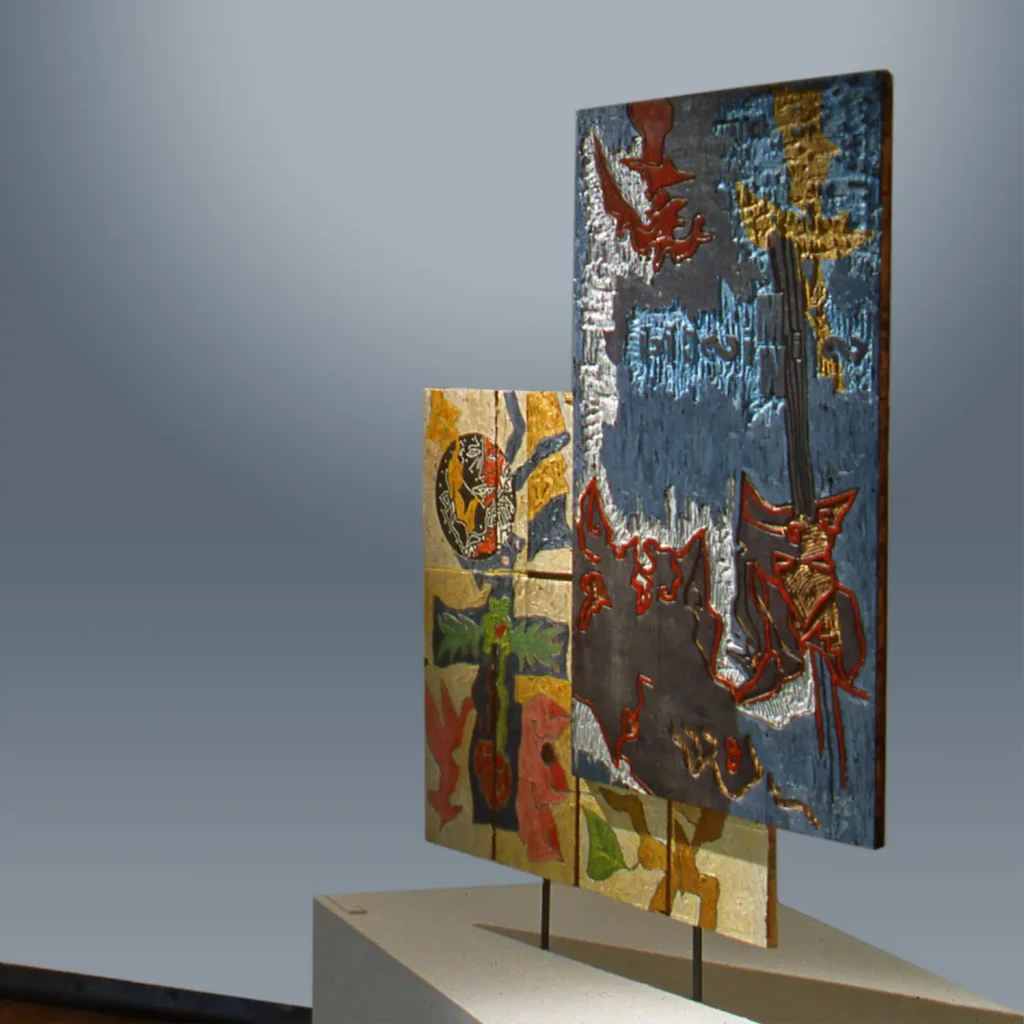
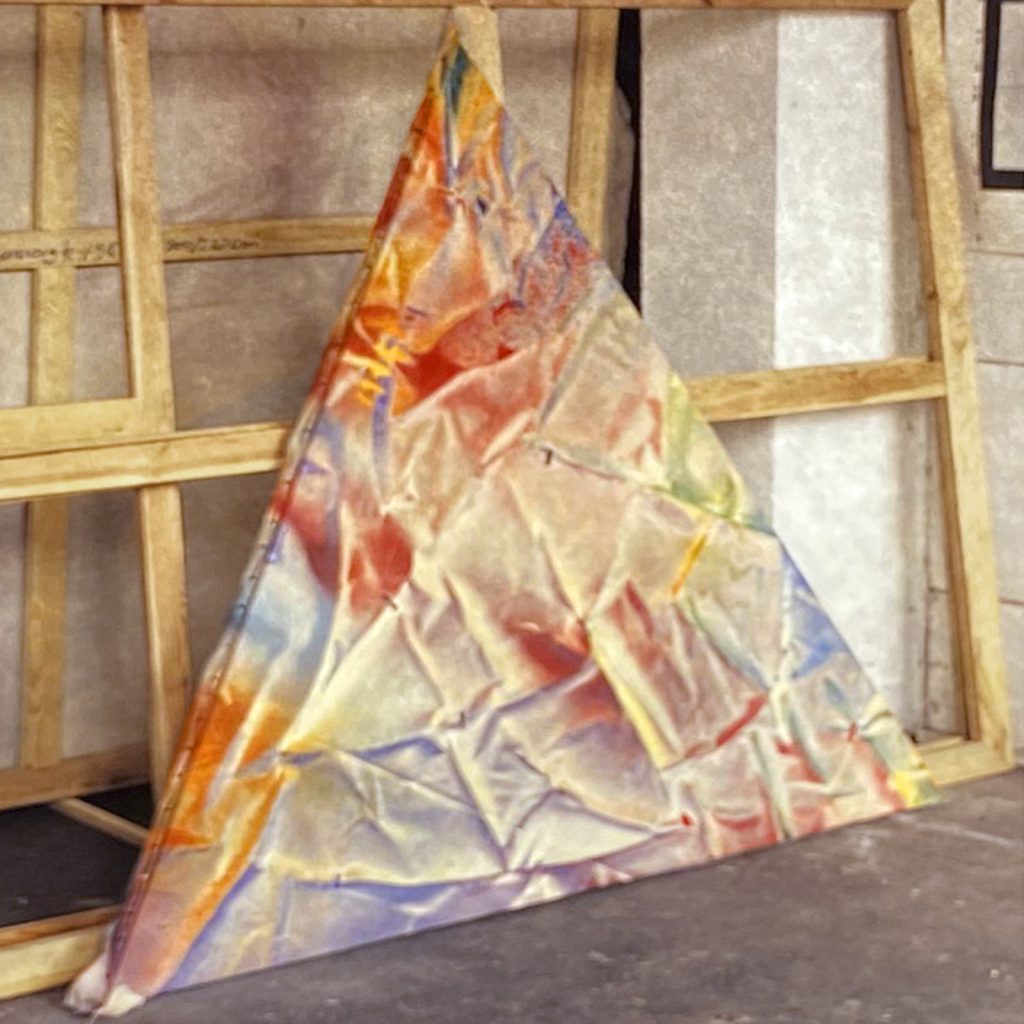
The tondo in all its states
Oil and collage on wood, diam. 140 cm
Private collection [1992 028]
Was it Cabu or Gotlib? I remember a cartoon showing a maths teacher wowing his pupils by drawing a perfect circle freehand in chalk on the blackboard. Just like that, it says it all: perfection of form; virtuosity of execution. For the round, the circle, the sphere belong to the symbolism of perfection, of purity, of completeness, of the infinite without beginning or end. Every culture in the world has made something of it, has said something about it. For the history of Western art it is the “Renaissance form” par excellence, but for Scanreigh it is one of the “renascent” forms that mark the turning point in his artistic approach. The tondo settled into his work for good in the early 90s.
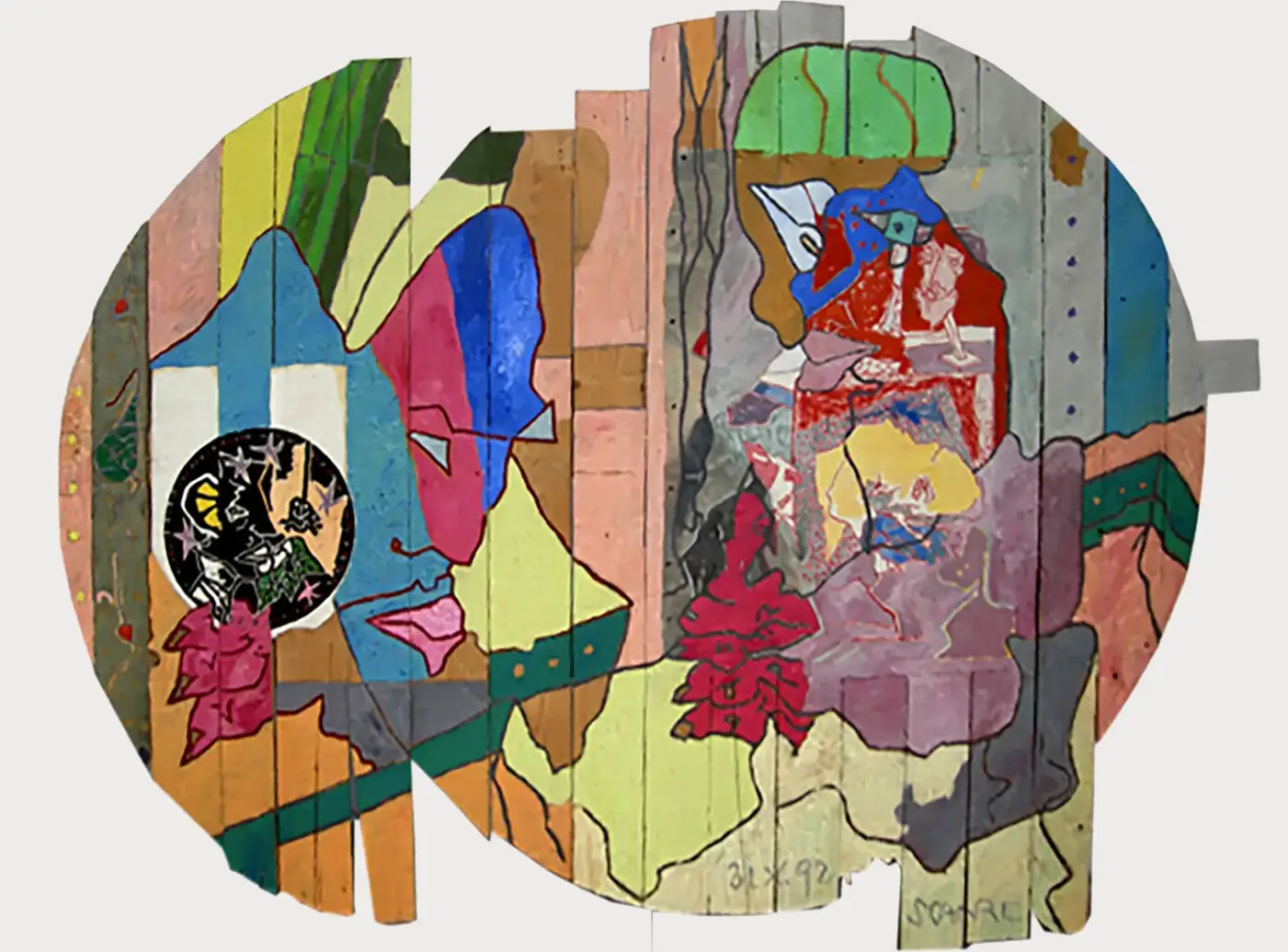
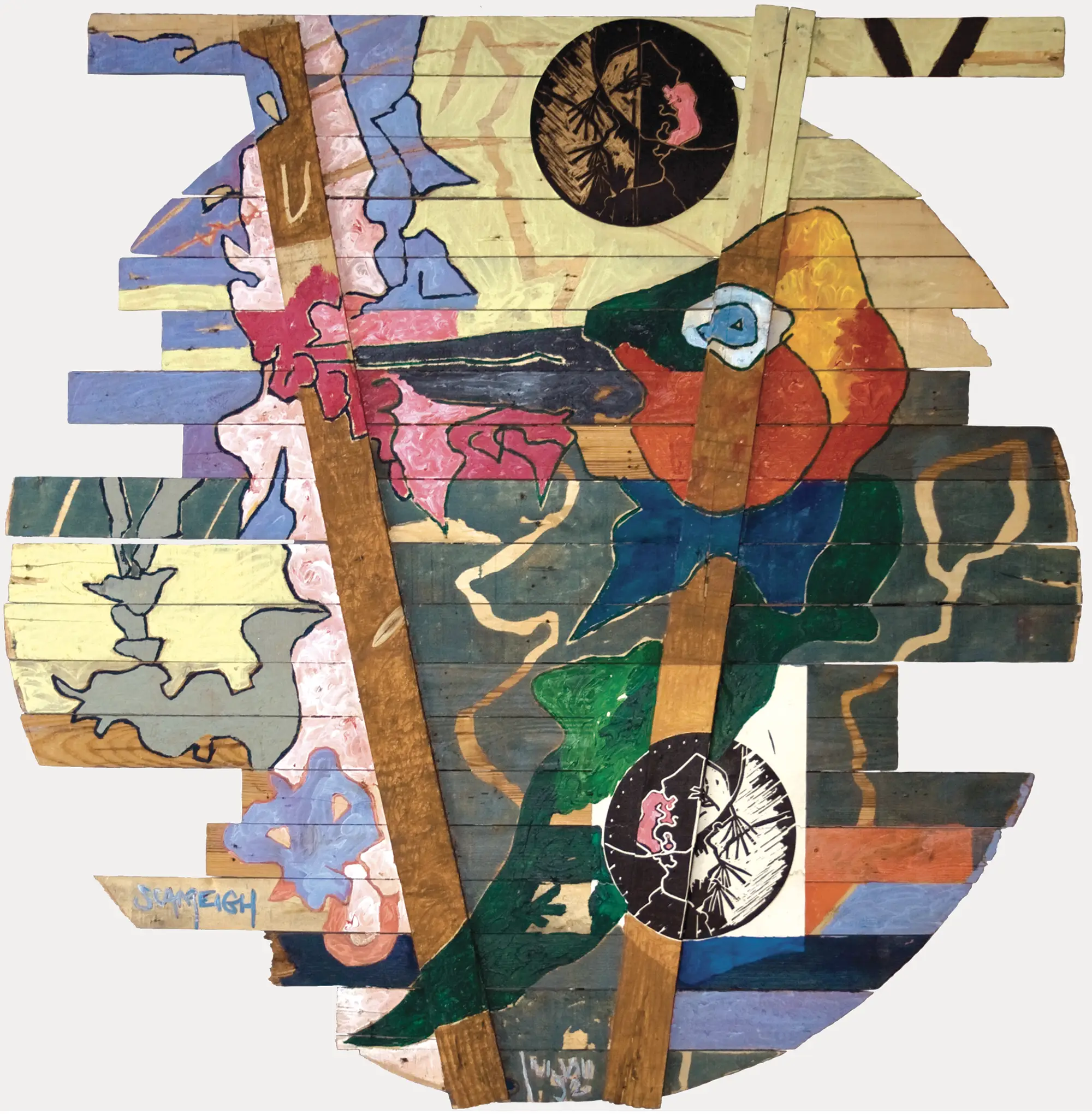
Oil and collage on wood
130 × 165 cm
Private collection [1992 023]
The form emerged of its own accord from dismembering the wood of the pallets with a jigsaw, pallets gleaned from the industrial premises that housed his studio and which Scanreigh set about cutting up and restructuring to make paintings. That the circular form – with all its symbolic charge – should spring up in his work shamelessly, in a roughly hewn way, is telling. In the carving-up of the parallelepiped pallets there is a private squaring of the circle to be solved, in which the slats, the “bands”, broken, shifted, are also the ones that gave rhythm to the abstract canvases of the “first manner”.
Scanreigh is an extractor of forms, a gesture that often proceeds from a pareidolic vision of reality. In his way of making the supports for his painting, in his way of cutting lino and wood, letting the mark of the tool suggest a drawing to him, he repeats the gesture that led him to pull out figures glimpsed in the illusionistic folds of his abstract painting. And still today his compositions are an assemblage of fragmentary samples caught furtively here and there in the visible world.
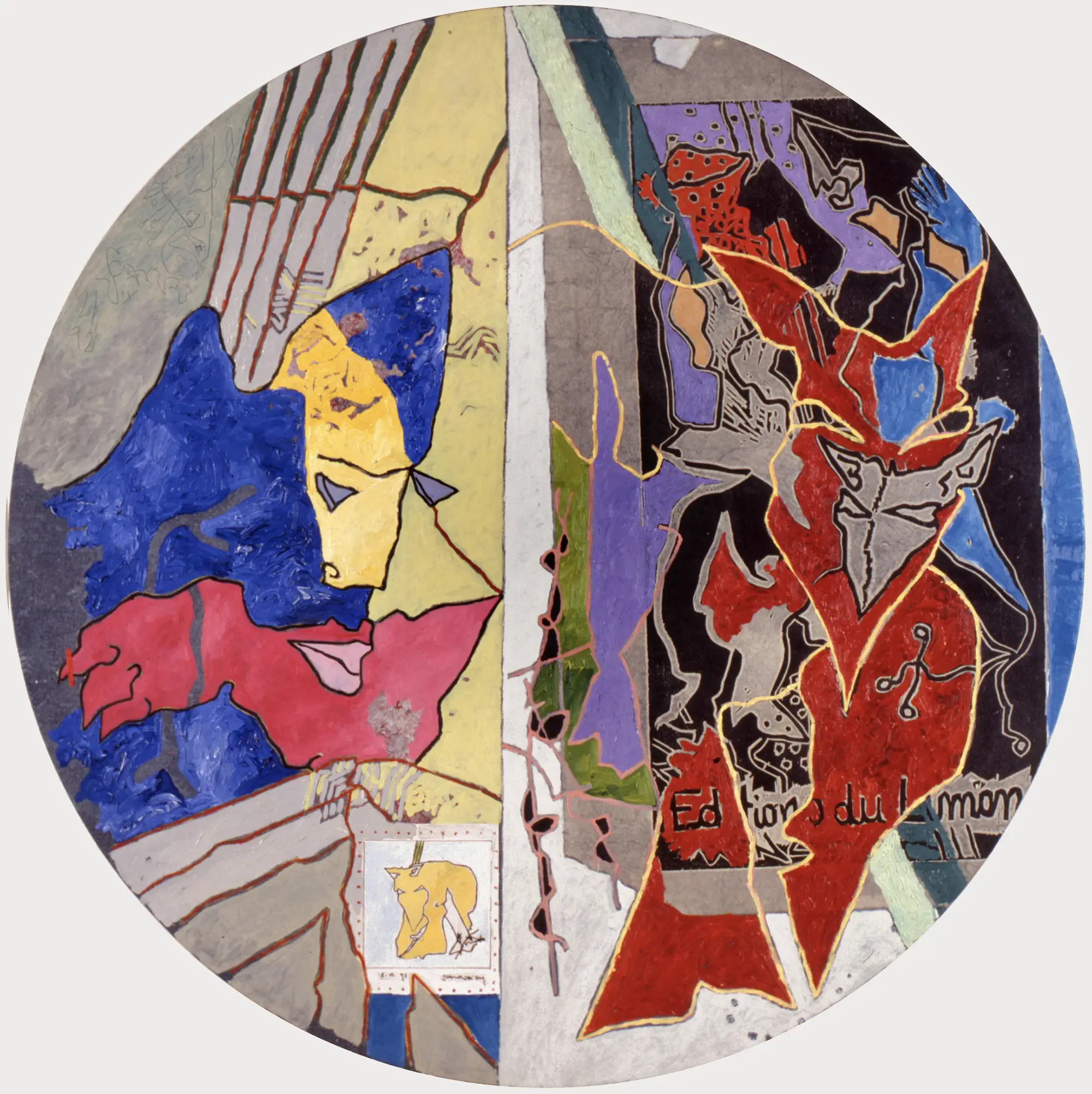
Oil and collage on canvas, diam. 120 cm
Private collection [1992 047]
After the cut-out wood, round stretchers, more orthodox, logically made their appearance. The round form also found its way into the drawings and prints that serve as collage just about everywhere in the paintings, the drawings and on the covers of the drawing notebooks. When I ask Scanreigh if he has anything to add on the subject, he says yes, but in the meantime what comes back to him is that round stretchers are easy to roll around the studio, like our grandmothers’ hoops!
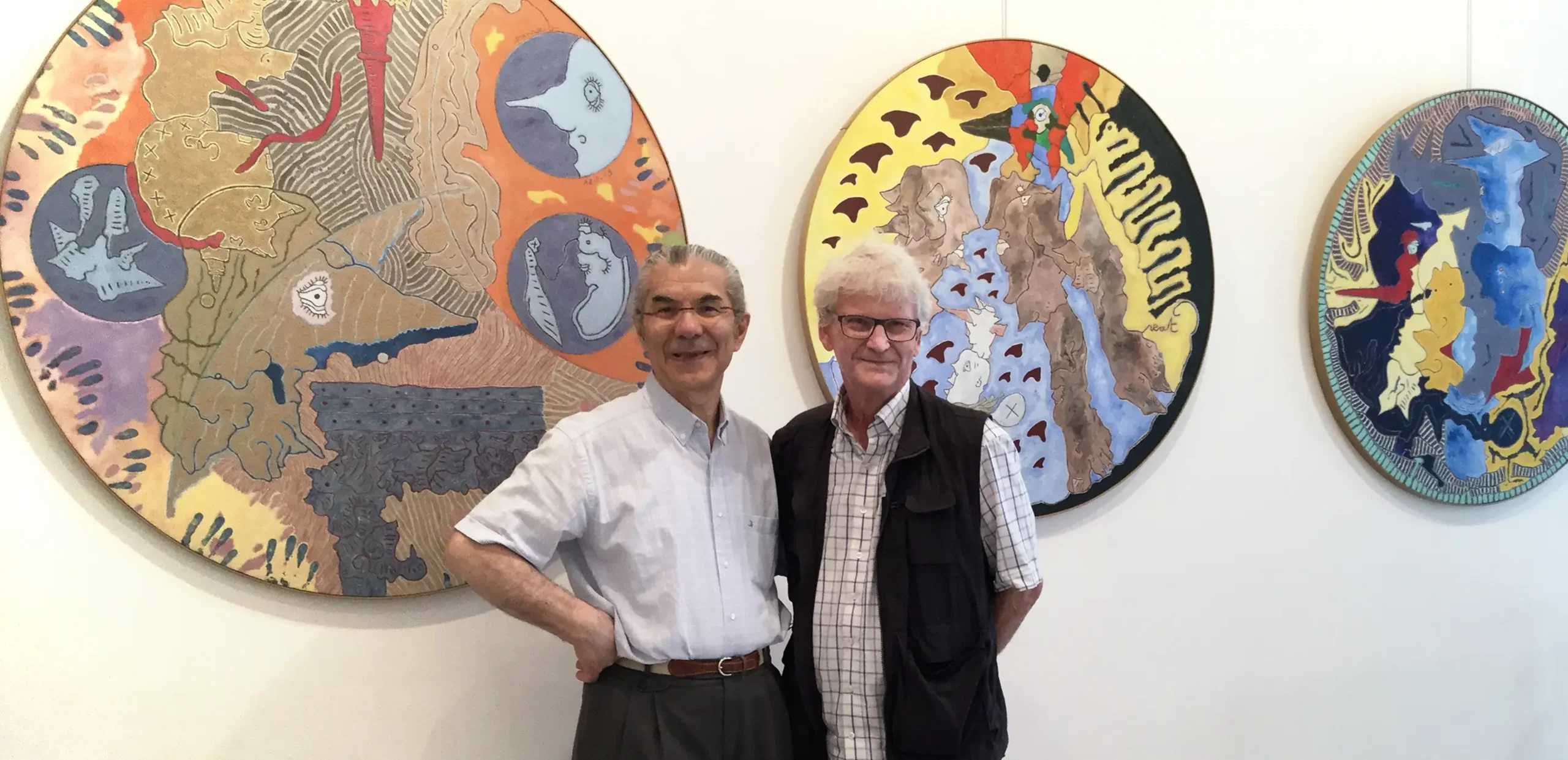
In 1993 the paintings on wood caught the attention of Claudine Lustman for Scanreigh’s third solo exhibition, Palettes et Tondi, in her gallery on rue Quincampoix in Paris. Sixteen years later, it was the curator Pascal Trarieux who conceived an exhibition entirely on the theme of the tondo at the Musée des Beaux-Arts de Nîmes.
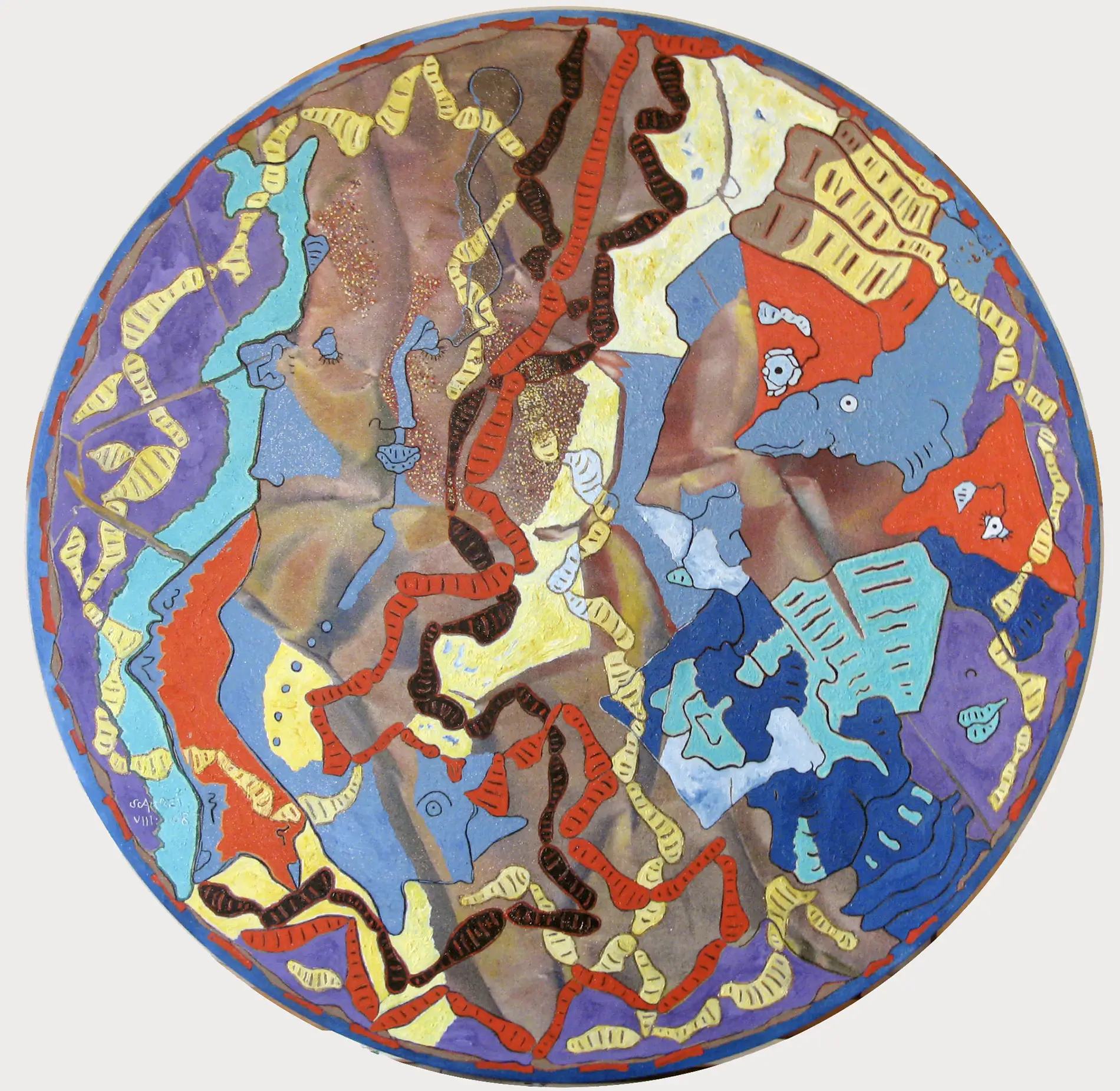
Private collection [2008 036]
This painting, made on an old canvas with crumpled effects, has reached the final stage, where all the earlier substrate has been engulfed by the figurative motifs it gave rise to.
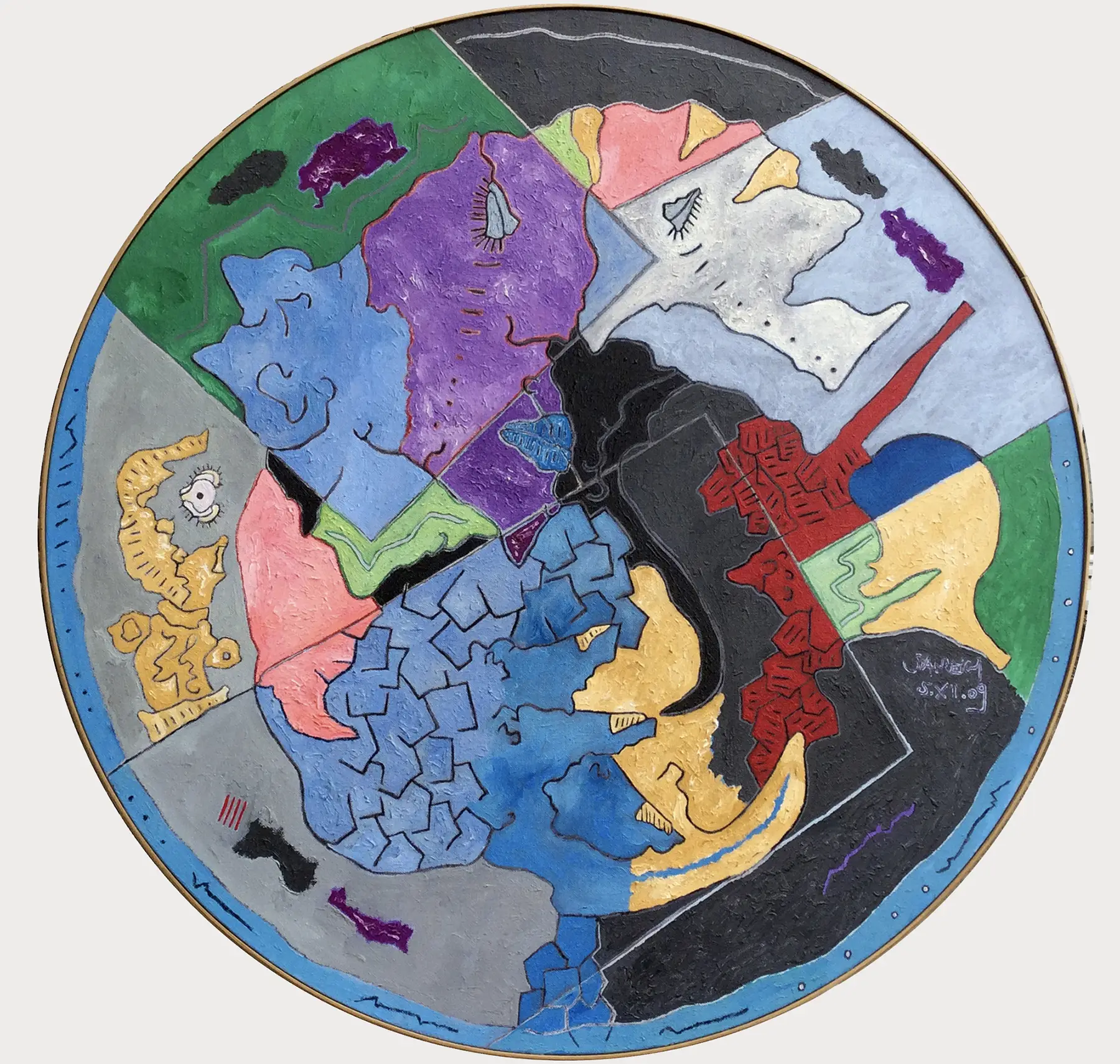
Oil on canvas, diam. 90 cm
Private collection [2009 007]
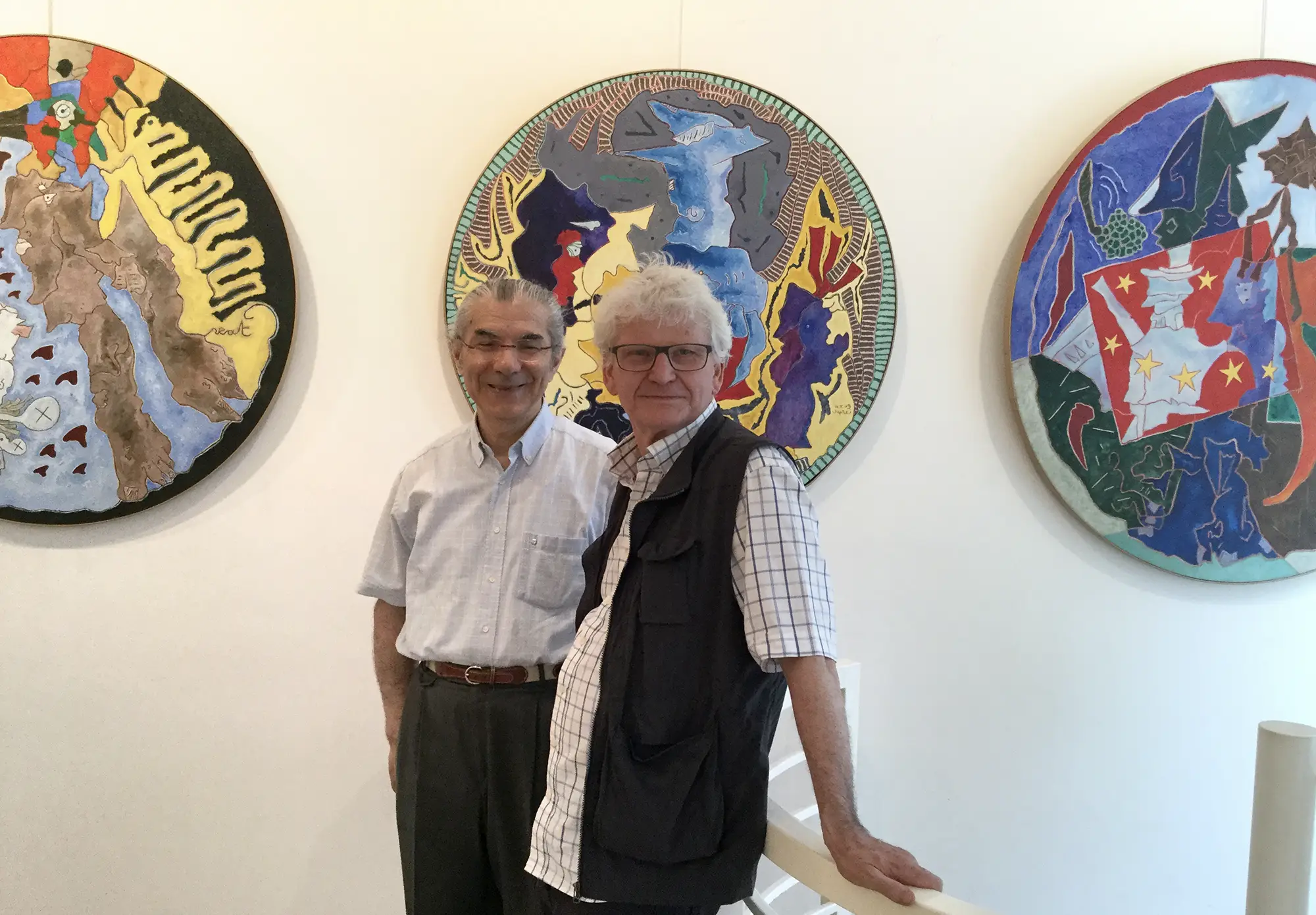
In 2017, Claude Lemand, a great collector, and a lover of tondos among other things, showed some in his Paris gallery. He owns six, one of which he presented as curator of the large group exhibition Tour du monde en tondo at the Musée Saint-Roch in Issoudun.
(The reader will have noticed the plural “tondos” instead of “tondi”; I prefer this less pedantic plural, which comes naturally in speech, just as one says “a scenario/scenarios”. The guardians of the dictionary will come round to usage in the end… and typographically, with their two “O”s, tondos make the case for this solution themselves). F.B.
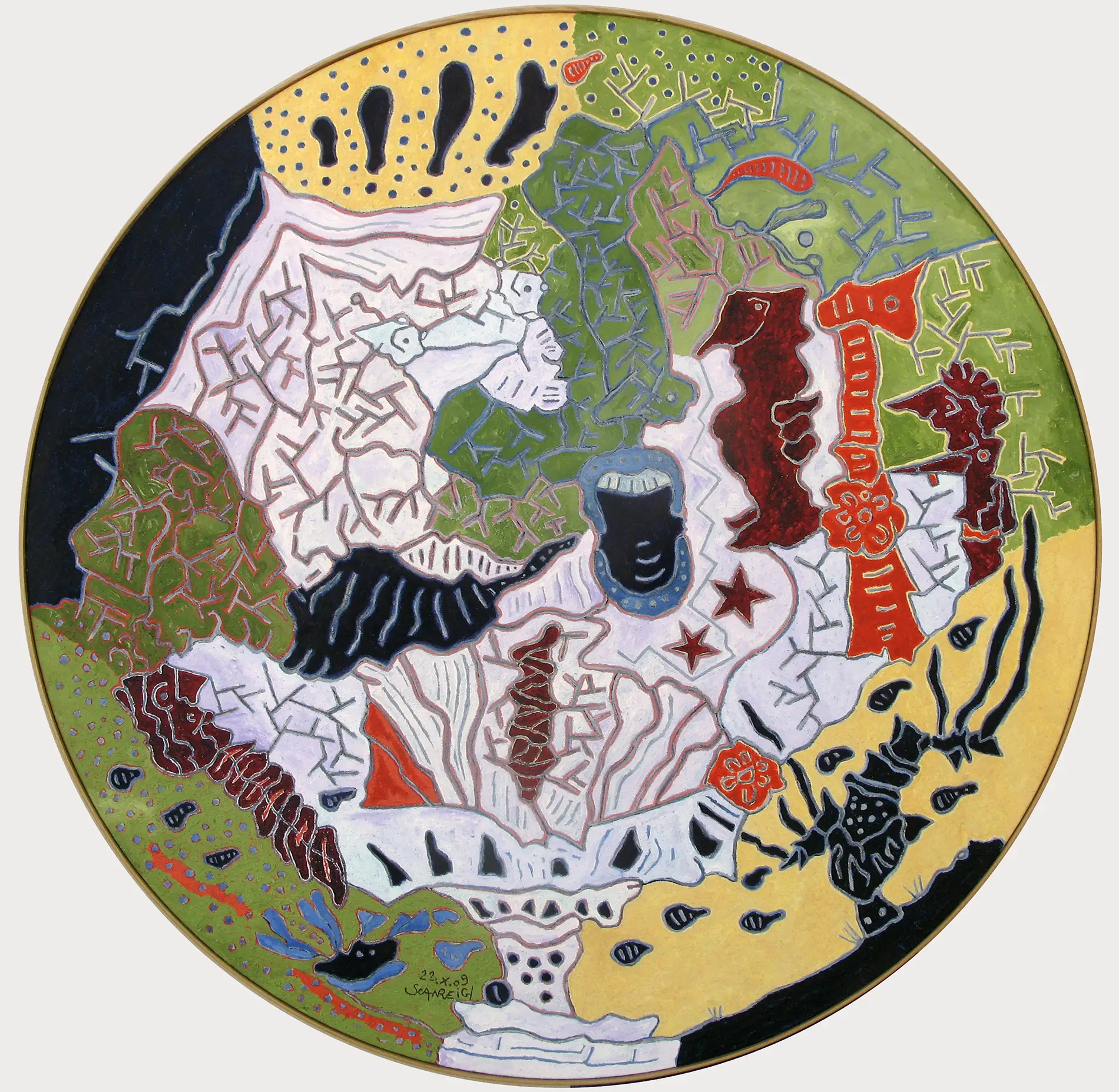
Oil on canvas, diam. 90 cm
Collection France & Claude Lemand
[2009 009]
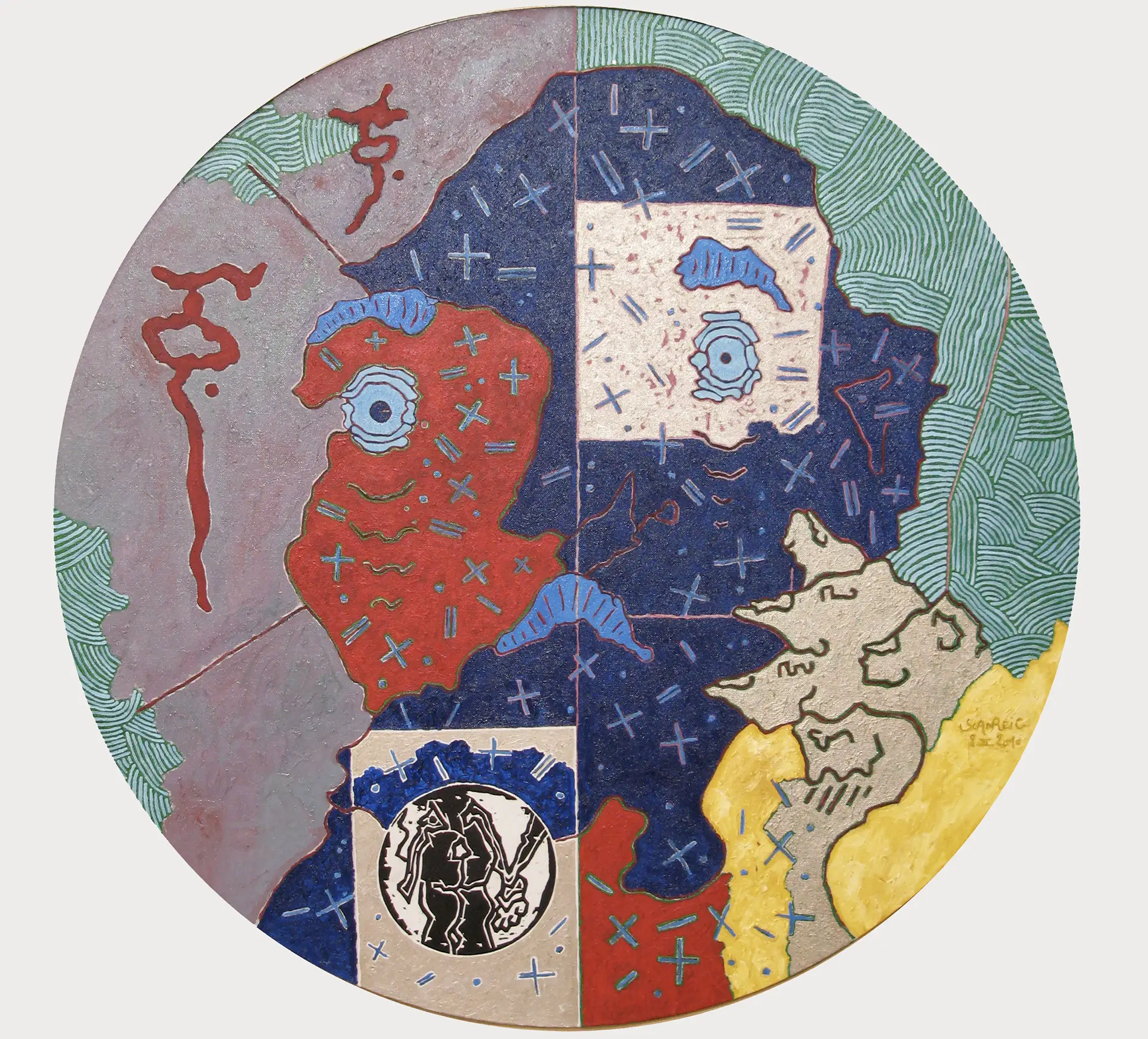
Oil and collage on canvas, diam. 90 cm
Collection France & Claude Lemand
[2010 030]
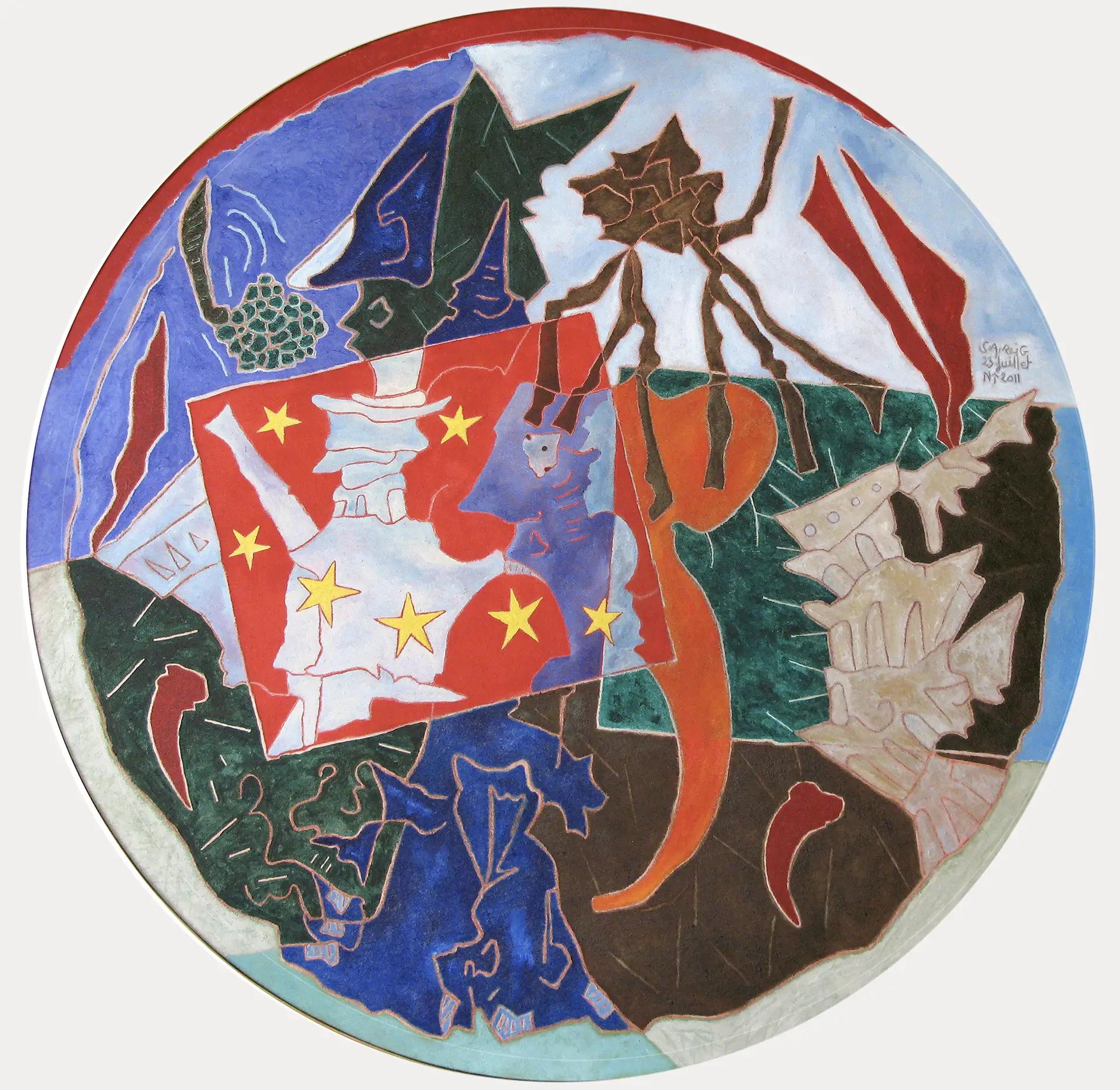
Oil on canvas, diam. 120 cm
Collection France & Claude Lemand
[2011 002]
________________________________
To finish, a quotation from Pascal Quignard taken from the book “Tondo”, after tondi (!) by Pierre Skira. Flammarion, 2002
Mire est la cible
Le tondo ne permet pas de multiplier les lignes de fuite.
Il concentre l'espace qu'il perfore. Rétrécissant le visible, il empêche de prendre ses distances à l'intérieur de ce qu'il excave.
Il immobilise celui qui voit.
On aperçoit ce bout de pupille à partir de laquelle le cercle prend axe. Il ferme l'angle. Il prépare sa giration.
La forme que se mit à peindre Pierre Skira en 2001 commença son aspiration.
Devint vertigineuse.
Alors les livres tournent comme des astres à partir de ce bout de peau, de paupière, de prépuce retroussé.
Le rond, quant aux archers, on le nommait la cible.