With André Spears
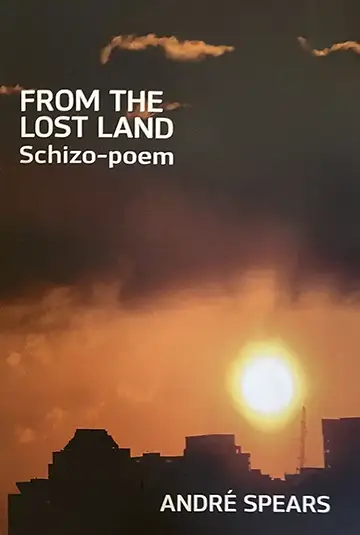
A quick word from André Spears in New York, letting us know of the publication of his latest book, his schizo-poem, a long-haul piece of work as he puts it… with content as demanding as ever.
The back cover states that nothing in American poetry comes as close to the formal approach used by Jacques Derrida in his book Glas (1974) as this new book by Spears. The same two-part structure: an epic poem on the one hand, set against a series of quotations on the other. "Il existe très peu d'œuvres dans la poésie américaine qui se rapprochent de l'énergie intertextuelle et de l'étendue des connaissances dont fait preuve Spears. Hors des radars du marché de la poésie de son propre fait, il est l'un des poètes les plus singuliers travaillant en langue anglaise".
A small remark in passing: this is not exactly what the look of the cover would lead you to expect, miles away from the poetic-literary graphic code practised by French publishing on this side of the Atlantic, for which Spears’s writings could only be conceived in a white cover, dry paper, preferably with a grain, prim typography and small point size! This gap is precisely what interests Spears, who plays at breaking down barriers and at the interference of registers in every field. So be it, then: avant-garde poetry got up as science fiction! Everything is of a piece for this New Yorker from Greenwich Village who, after a 25-year top-level career in Greek-American shipping, has devoted himself to literature. With a doctorate in comparative literature, he published articles in American and Canadian academic journals before turning to poetry and to “experimental” literature, to put it briefly, attentive to the most current cultural mutations and interconnections.
In 2010, in our late lamented former blog, we had commented on a text André Spears had devoted to the tribute exhibition to Miles Davis, We want Miles, at the Cité de la Musique in Paris. In it he noted that jazz’s opening out towards the creative forms of the pop-rock-rap scene is a phenomenon also observed in poetry, and that the forms of its renewal are deeply rooted in the digital revolution.
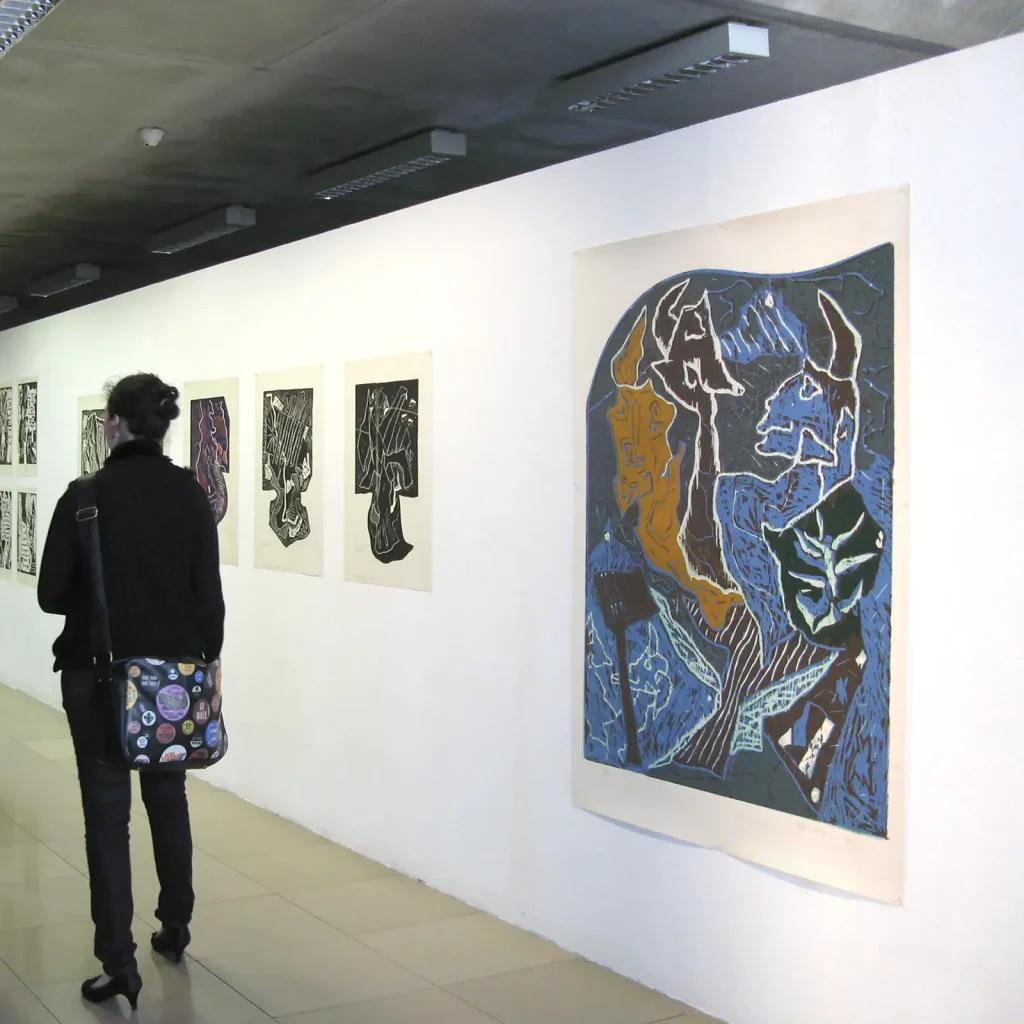
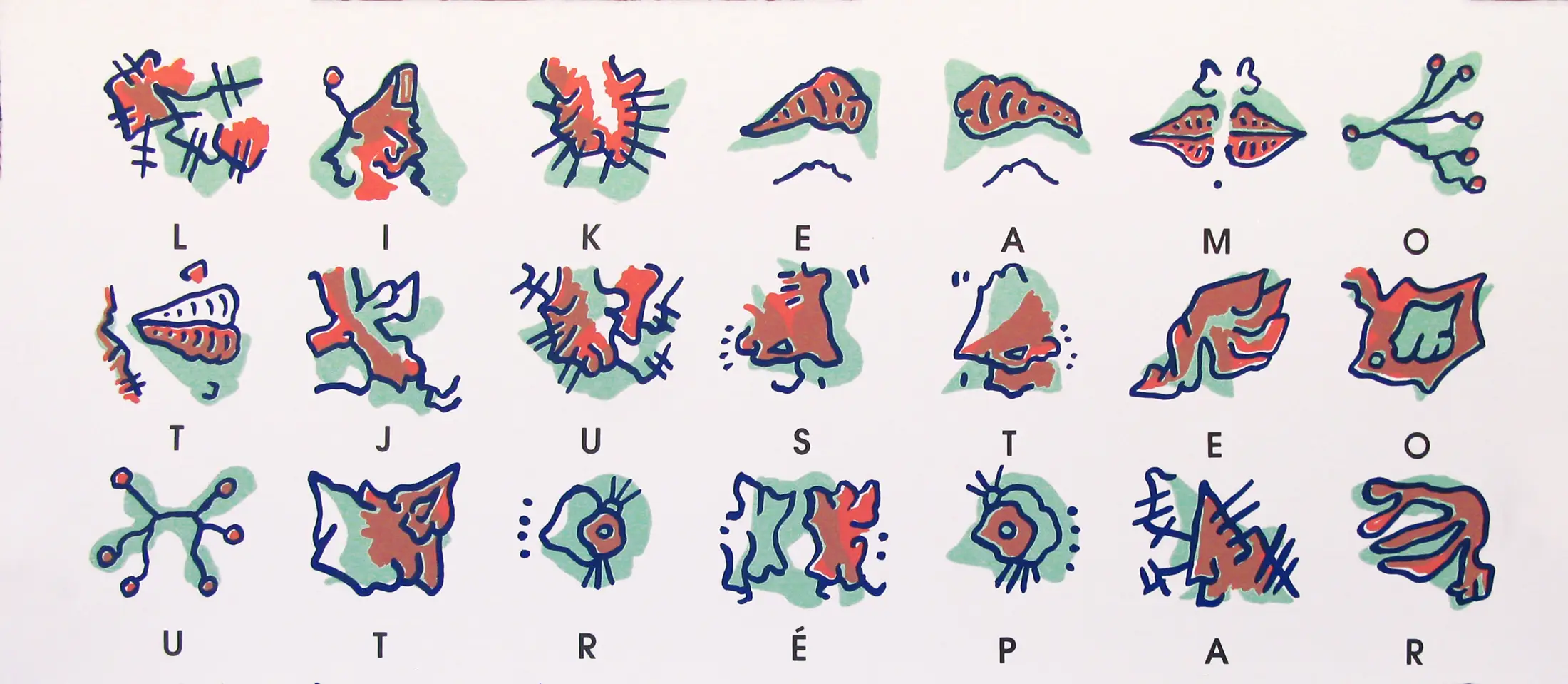
It was in fact by way of its cross-border ramifications that Scanreigh and André Spears met in New York in November 2000. Scanreigh was presenting his “broadsides”, made with writers and poets, at Columbia University. By an almost natural chain of events, the idea of a collaboration was born. It began with two artists’ books, then went on with a project of 50 prints based on French expressions that have passed into American English. Each of the broadsides begins with “Like” followed by a logico-poetic combination, a sort of linguistic graft itself fixed in the image. A few examples of this collaboration were shown in 2010 at the Cabinet d'Amateur in Paris, then a larger set at the Bibliothèque du Carré d'Art in Nîmes in 2011.
In France, André Spears, like Scanreigh, is on the exceptional list of the publisher and visual artist Richard Meier / Voix Éditions, who has published several books by Spears illustrated by the Swiss artist Gilgian Gelzer. F.B.
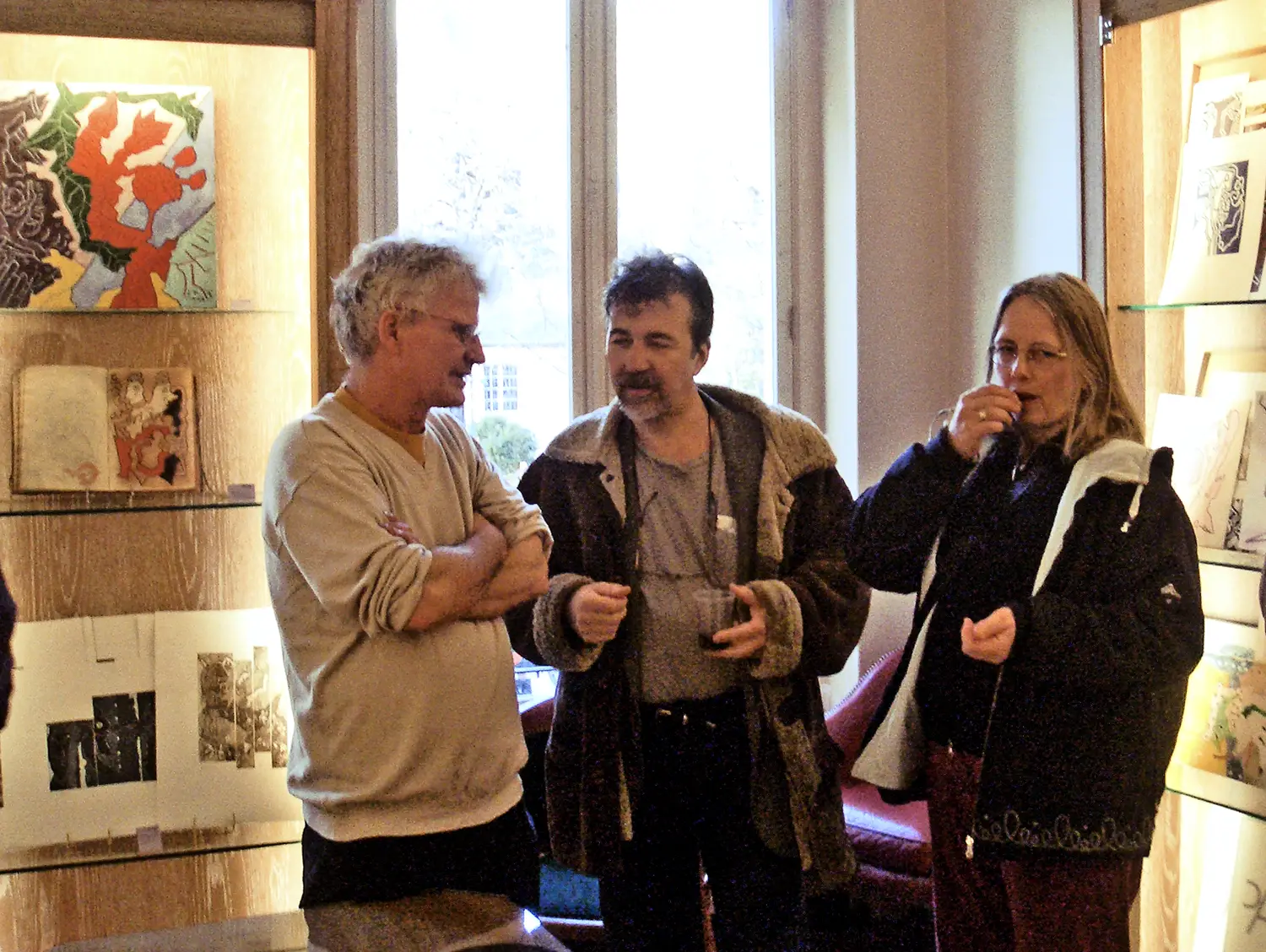
Exhibition, Librairie-galerie Nicaise, Paris
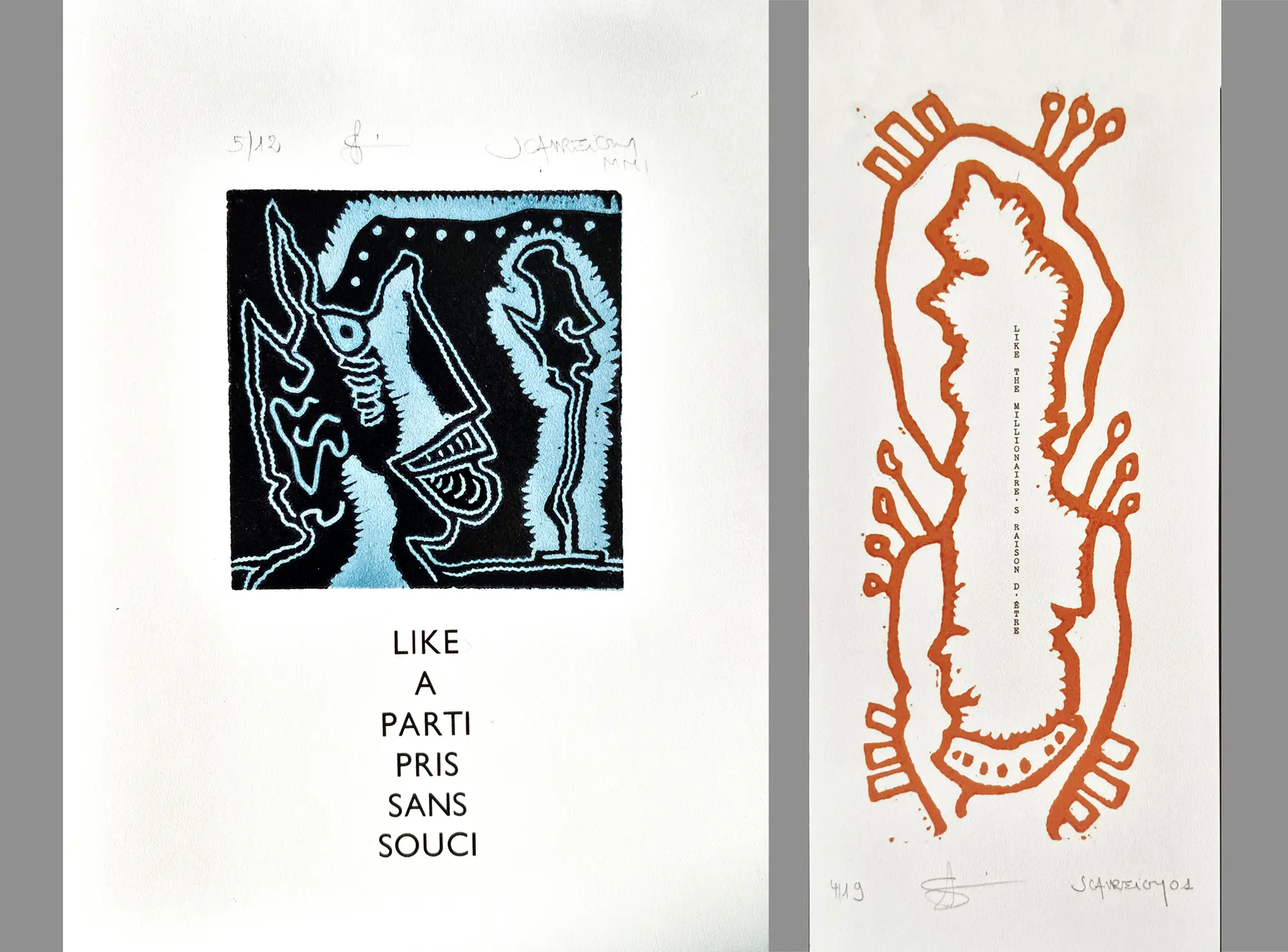
Woodcut with text printed letterpress by Pierre Voisin
12 impressions on Zuber coated paper, 43 × 38 cm
[E 2001 020]
on the right: Like the Millionaire's Raison d'Être, 2001
Text printed letterpress by Pierre Mréjen, Marseille
Woodcut in an edition of 19 on white coated paper, 45 × 18 cm
[E 2001 033]
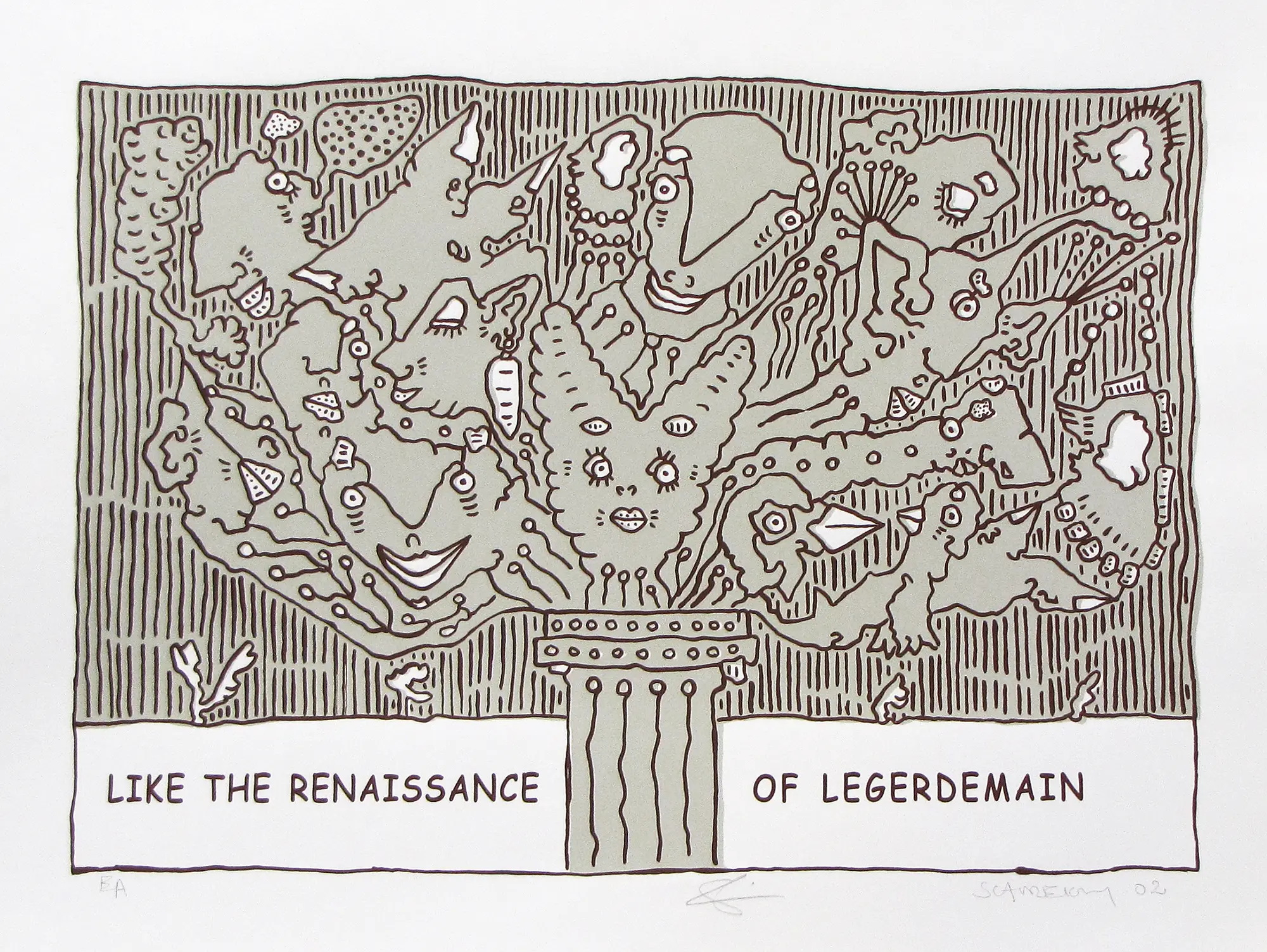
Screenprint in two colours, signed and numbered
Atelier La Fraternelle, Saint-Claude
30 impressions, 44 × 62 [58 × 77] cm
[E 2020 042]
*Legerdemain is a word which, despite its sound, no longer exists in French. In modern English it is the survival of a medieval form borrowed from Old French, meaning “léger de main”, that is, so nimble-fingered as to create illusions for others, like a conjuror.
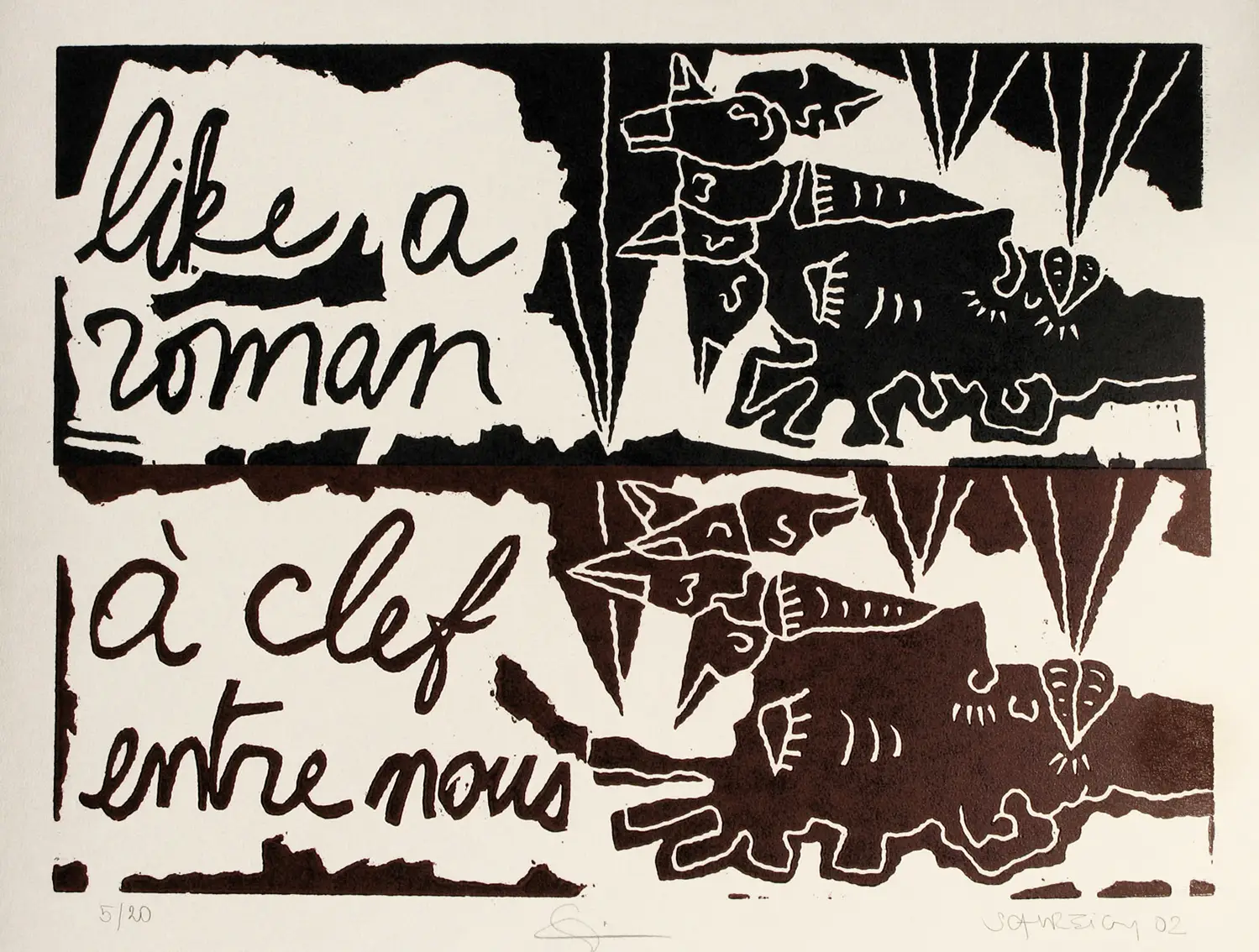
Woodcut with text cut after the author’s manuscript
on Zuber coated paper, 20 impressions, 50 × 66 cm
[E 2002 027]
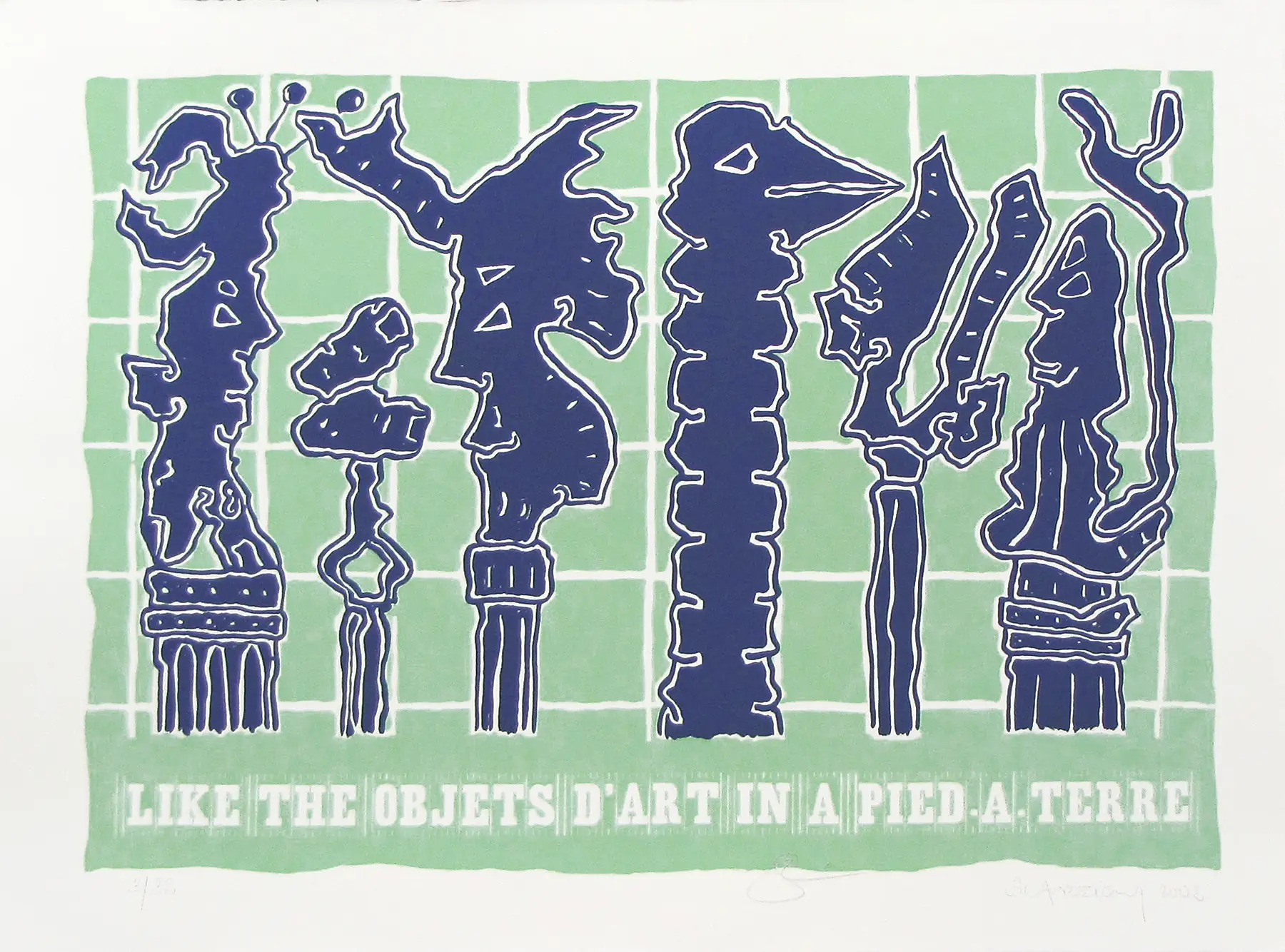
Screenprint in two colours, signed and numbered
Atelier La Fraternelle, Saint-Claude
47 × 67 [56 × 76] cm, 32 impressions on Arches 88
[E 2002 041]
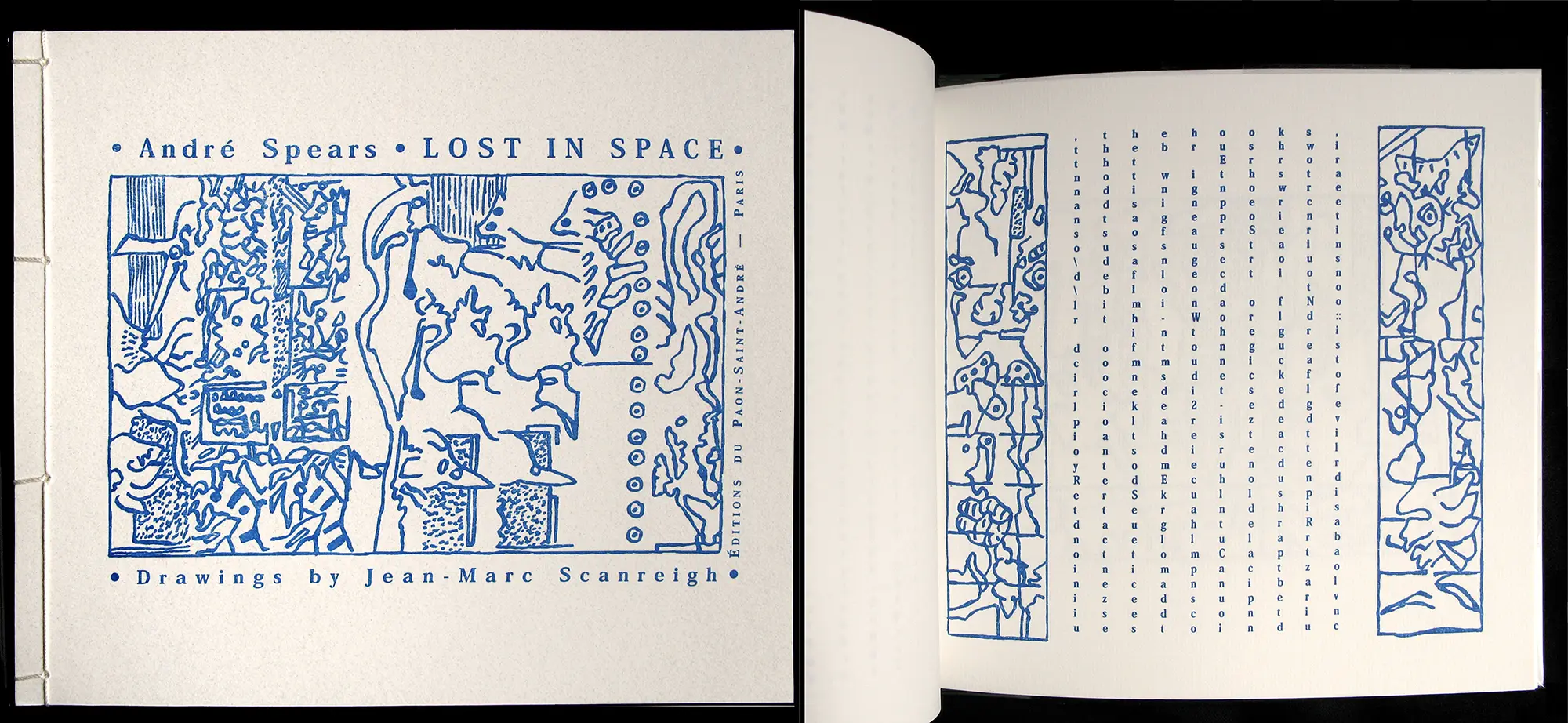
André SPEARS, Lost in Space
Éditions du Paon-Saint-André, Paris, 2001. 24.2 × 20.8 cm. (30) pages, stab-bound. English text by André Spears set in blue on 120 gsm laid paper, accompanied by 12 line drawings; the whole in a Countryside Mineral Chalk 250 gsm cover. Edition of 100 copies numbered 1 to 100, signed by the artist, the first 30 of which include an original drawing in black Indian ink heightened with watercolour. [L 2001 013]
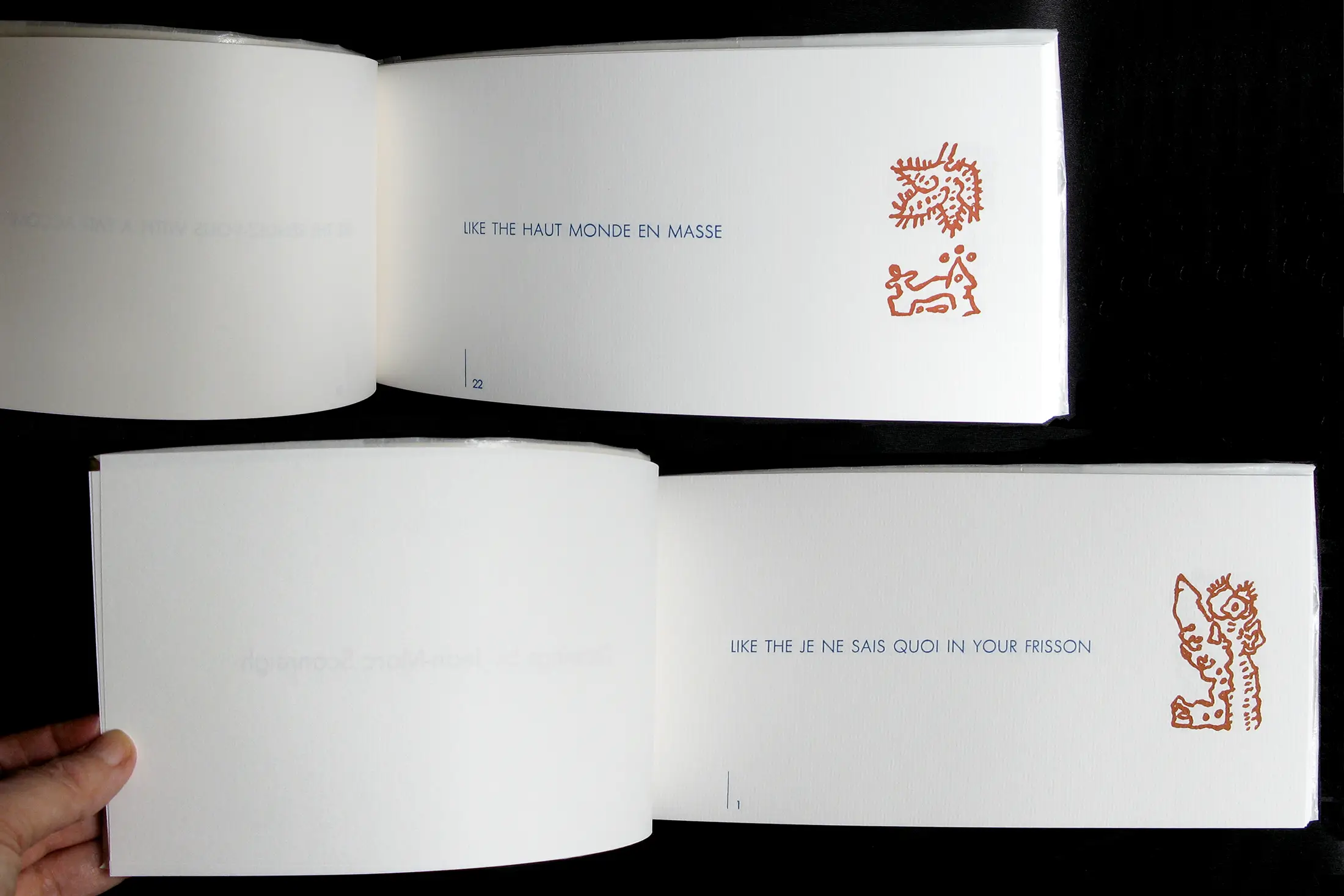
André SPEARS, United States
Édition de l’Oiseau qui dit tout, Brussels, 2002. 24 × 11.3 cm. (108) pages, stab-bound. Franco-American texts by André Spears, printed in blue on natural white Rives, accompanied by 50 line drawings in red; the whole in a grey cover with the titles United States, États-Unis embossed on a fly press. This book prefigures a suite of 50 prints with text (broadsides) on the same principle: a Franco-American text by André Spears and a woodcut by Jean-Marc Scanreigh. Edition of 100 copies, numbered 1 to 100, signed by the artist, the writer and the typographer, the first 30 of which include an original drawing in black Indian ink, dated and signed by the artist. [L 2002 011]